

Voluntary GST Registration: Benefits, Risks & Process (2026 Guide)
In the Indian corporate ecosystem, taxation is not a matter of morality; it is a matter of strict statutory mathematics. By law, if your aggregate business turnover remains below the mandatory thresholds—₹40 Lakhs for exclusive goods suppliers in normal states, and ₹20 Lakhs for service providers—you are completely exempt from taking a Goods and Services Tax (GST) number. You are legally allowed to operate in the shadows.
So, why would any sane business owner invite the taxman into their books early? Why would a startup proactively trigger strict compliance requirements before the law forces them to?
The answer lies in Section 25(3) of the Central Goods and Services Tax (CGST) Act, 2017. This section permits Voluntary GST Registration. For forward-thinking entrepreneurs, taking a voluntary GSTIN is a calculated financial strategy. In this raw, unfiltered guide, we tear down the fluff. We will dissect the absolute truth about GST Registration Benefits, expose the compliance risks that nobody warns you about, and map out the exact GST Registration Process you must follow in 2026.

The Statutory Framework: What is Voluntary GST Registration?
Before diving into the GST Registration Benefits, let us clarify the law. Under Section 25(3) of the CGST Act, any person, though not liable to be registered under Section 22 or Section 24, may get registered voluntarily. However, the moment you obtain that 15-digit GSTIN, you are treated exactly like a mandatorily registered taxpayer.
The ROI: Analyzing GST Registration Benefits
We do not deal in empty marketing jargon. If you are going to take on the burden of monthly tax filings, there must be a tangible return on investment. Here are the precise GST Registration Benefits that make voluntary compliance highly profitable for the right businesses.
| Statutory Benefit | How It Impacts Your Business Financially |
|---|---|
| 1. Unlocking Input Tax Credit (ITC) | This is the most aggressive of all GST Registration Benefits. Without a GSTIN, the 18% or 28% GST you pay on raw materials, office rent, and software is a dead cost. With Voluntary GST Registration, this tax is credited back to your electronic credit ledger, reducing your final tax liability. It is literally cash saved. |
| 2. Seamless B2B Scaling | Large registered corporations will not do business with unregistered vendors. Why? Because they cannot claim ITC on your unregistered invoices. A voluntary GSTIN upgrades your corporate standing, allowing you to seamlessly integrate into the supply chains of larger enterprises. |
| 3. Inter-State Supply & E-Commerce | While recent amendments allow limited unregistered intra-state e-commerce, operating at scale on Amazon, Flipkart, or ONDC requires a GSTIN. If you plan to sell goods across state borders (e.g., Delhi to Maharashtra), Section 24 mandates registration immediately, making your Voluntary GST Registration a preemptive masterstroke. |
| 4. Improved Banking & Credit Trust | Banks and NBFCs heavily rely on GSTR returns to sanction business loans and overdraft limits. A legitimate GSTIN and filed returns serve as undisputed, government-backed proof of your business income, expediting capital procurement. |
The Dark Side: Compliance Risks You Cannot Ignore
At VALIDRAFT, we tell our clients the exact truth. The GST Registration Benefits are powerful, but they are not free. Voluntary compliance comes with a strict operational leash.
- Relentless Return Filing: Depending on your scheme (QRMP or monthly), you must file GSTR-1, GSTR-3B, and an Annual Return (GSTR-9). Filing “Nil” returns is mandatory even if you made zero sales in a month.
- Brutal Penalty Structures: Forget to file your GSTR-3B? Late fees accrue daily (₹50 per day for regular returns, up to maximum statutory limits). Consistent default will result in the suspension of your GSTIN and potential freezing of bank accounts.
- Cash Flow Blockage: You must deposit the GST you collect from your clients to the government by the 20th of the following month. If your client delays payment to you by 90 days, you still have to pay the tax from your own pocket first.
The 5-Step GST Registration Process (2026 Updated)
If the data dictates that your business requires Voluntary GST Registration, you must execute the setup flawlessly. A single mismatch in PAN data or business address proof will result in a Show Cause Notice (SCN) from the Jurisdictional Officer. Here is the exact GST Registration Process.
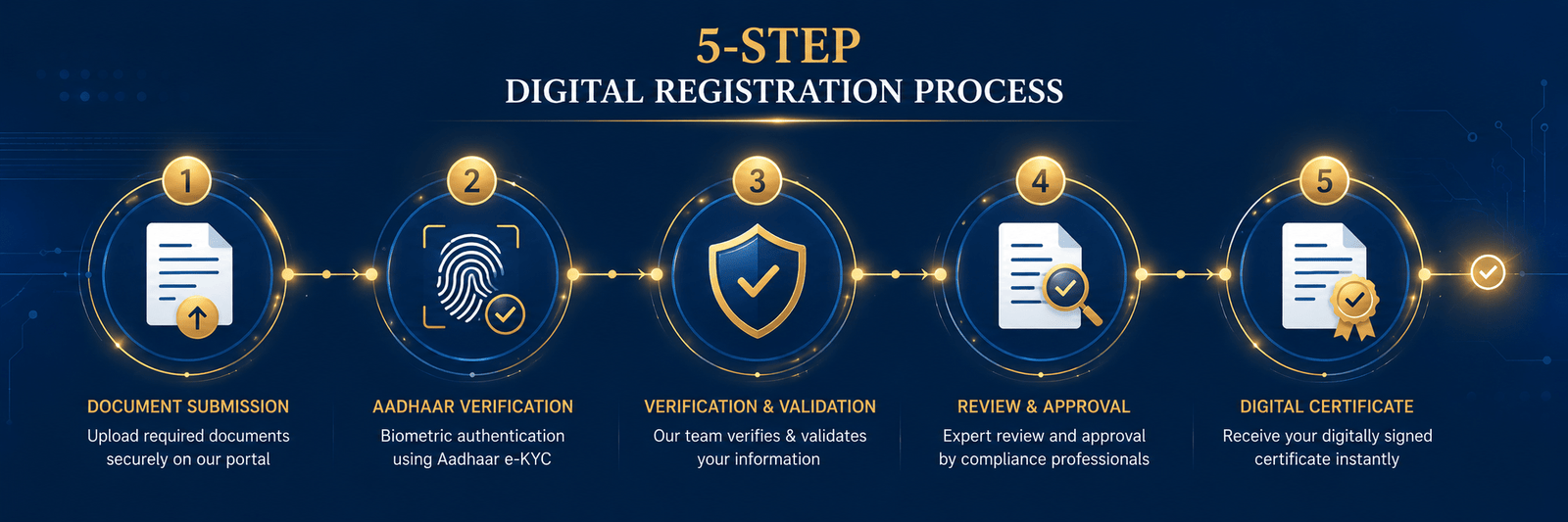
- TRN Generation (Form GST REG-01 Part A): Navigate to the official GST Portal. Enter your legal name, PAN, mobile number, and email. The system verifies this against the CBDT database and generates a Temporary Reference Number (TRN).
- Filing the Core Application (Part B): Using the TRN, log back in. You must meticulously upload proof of business constitution (Partnership Deed/Incorporation Certificate), identity proofs of promoters, and rock-solid proof of the Principal Place of Business (rent agreement combined with the latest electricity bill).
- Aadhaar Authentication: As of recent stringent mandates, Aadhaar authentication is mandatory for a swift GST Registration Process. If the promoters successfully authenticate their Aadhaar online, the registration is generally fast-tracked. Failure or opting out triggers physical verification of your premises.
- Application Reference Number (ARN) Tracking: Upon successful submission, an ARN is generated. The tax officer has a strictly defined statutory window to review your documents. If they find discrepancies, they will issue Form GST REG-03 seeking clarification. You must respond with Form GST REG-04 within 7 working days.
- Issuance of GSTIN & Bank Update: Once the officer is satisfied, Form GST REG-06 is issued containing your 15-digit GSTIN. Critical Rule: You must update your live current bank account details on the portal within 30 days of registration or before filing your first GSTR-1, failing which your registration will be instantly suspended.