
DPIIT Startup India Recognition 2026:
Tax Holiday, Angel Tax Exemption & Step-by-Step Application
Everything a founder needs to secure DPIIT recognition, claim the Section 80-IAC tax holiday, and understand the angel tax position in FY 2025-26.
Startups Recognised
by DPIIT (cumulative)
Government Fee
for Recognition
Tax Holiday
Under Section 80-IAC
Eligibility Window
from Incorporation

- Zero government fee: DPIIT startup recognition 2026 costs ₹0 — the entire process runs online via startupindia.gov.in or nsws.gov.in, with recognition typically issued within 1–3 working days.
- Section 80-IAC tax holiday: Eligible Private Limited Companies and LLPs incorporated between April 1, 2016 and March 31, 2030 can claim 100% income tax exemption on profits for 3 consecutive years out of their first 10 — provided they obtain an Inter-Ministerial Board (IMB) certificate.
- Angel Tax abolished: Section 56(2)(viib) — the so-called angel tax — was abolished with effect from FY 2025-26 via the Finance Act 2024. DPIIT-recognised startups raising equity in FY 2025-26 onward are not subject to it.
- Eligibility cap: Your entity must be under 10 years old from incorporation and must not have exceeded ₹100 crore annual turnover in any financial year since formation.
- Partnership firms excluded from 80-IAC: Section 80-IAC tax exemption is available only to Private Limited Companies and LLPs — not to registered partnership firms, even if DPIIT recognised.
If you incorporated a startup this financial year — or are planning to apply in April — securing DPIIT startup recognition 2026 is the single most impactful government action you can take in the next 72 hours. Recognition unlocks the Section 80-IAC tax exemption startup framework, self-certification under 9 labour laws, SISFS seed funding eligibility, GeM procurement access, and IPR fee rebates. This guide covers the eligibility criteria, the step-by-step Startup India registration process, and the correct legal position on angel tax as of March 2026.
1 What Is DPIIT Startup Recognition — and Why April Matters
DPIIT startup recognition is an official certification issued by the Department for Promotion of Industry and Internal Trade (under the Ministry of Commerce and Industry) confirming that your entity qualifies as a “startup” under GSR notification 108(E). It is not a registration or incorporation — it is a recognition layer on top of your existing company, LLP, or partnership deed.
April is the start of a new financial year, making it the strategically correct month to apply. A startup that obtains DPIIT recognition in April 2026 and subsequently secures an 80-IAC certificate from the Inter-Ministerial Board can elect to take its 3-year tax holiday starting from FY 2026-27 — maximising years of coverage within the 10-year eligibility window. Applying in March and waiting until April confirmation achieves the same outcome; applying in September costs you 5 months of planning runway.
2 Eligibility Criteria for DPIIT Startup Recognition 2026
All four conditions below must be satisfied simultaneously. Missing even one disqualifies the application.
| Criterion | Requirement | Disqualifier |
|---|---|---|
| Entity Type | Private Limited Company, LLP, or Registered Partnership Firm | Sole proprietorship, OPC, trust, society |
| Age | Not more than 10 years from date of incorporation | Entity older than 10 years at time of application |
| Turnover | Annual turnover < ₹100 crore in every financial year since incorporation | Even one FY exceeding ₹100 Cr cap voids eligibility |
| Innovation / Scalability | Working toward innovation, development, or improvement of products/services — OR has a scalable business model with employment/wealth creation potential | Routine businesses, spin-offs from existing companies, reconstruction of existing business |
The “innovation” criterion is assessed subjectively by DPIIT reviewers. Vague descriptions — “we sell products online” — are the most common cause of rejection or delay. Write your business description with clarity: identify the specific problem, the novel approach, and the scalability mechanism.
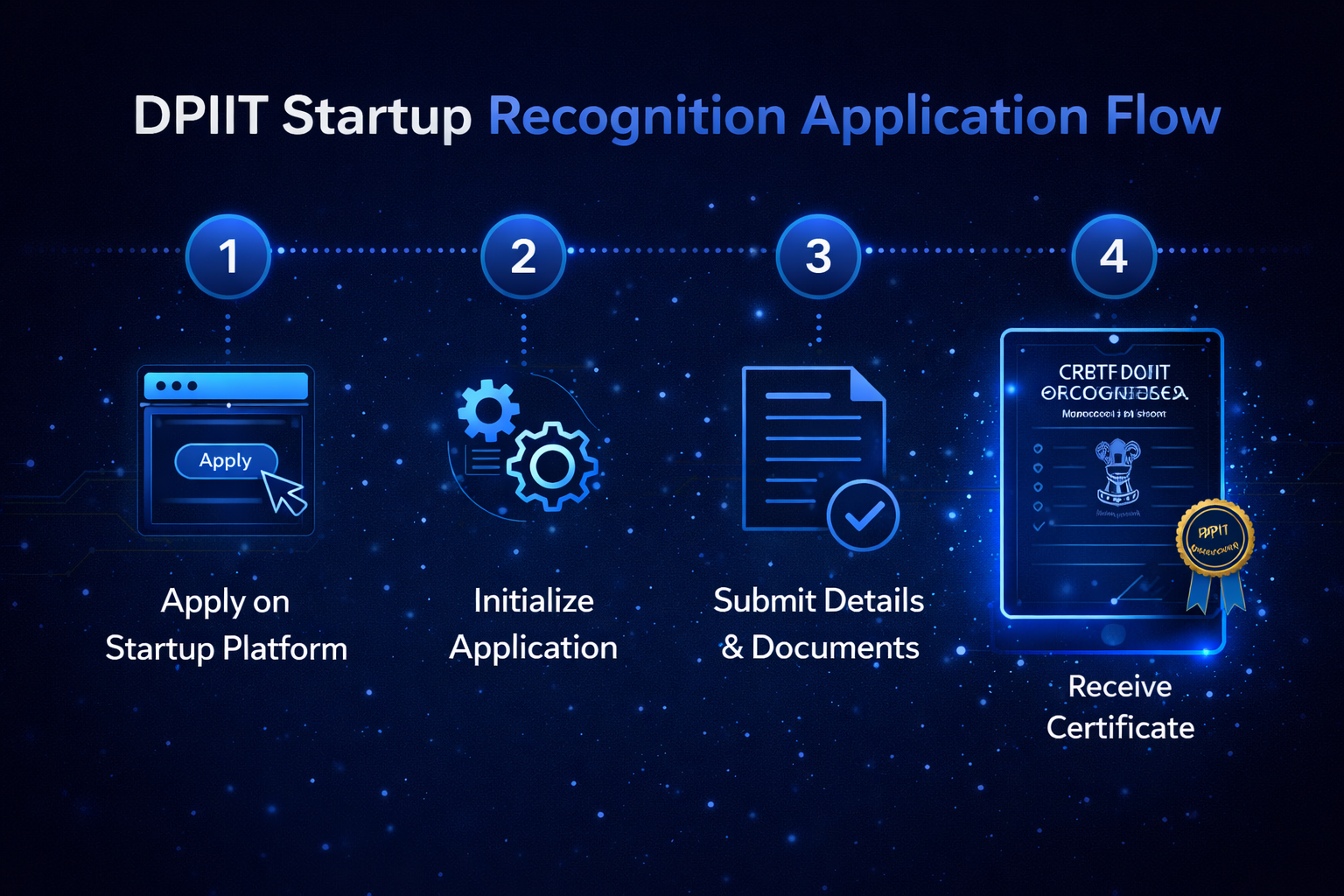
3 Step-by-Step Startup India Registration Process (2026)
The Startup India registration process in April 2026 runs entirely online. There are no physical submissions. Below is the complete sequence, from incorporation to certificate.
4 Documents Required for DPIIT Startup Recognition
The recognition application asks for documents in PDF format. Having all of these ready before you open the form reduces your submission time to under 30 minutes.
- ✓Certificate of Incorporation (issued by MCA) / LLP Formation Certificate / Registered Partnership Deed
- ✓PAN Card of the Company / LLP
- ✓MoA and AoA (for Private Limited Companies) — or LLP Deed (for LLPs)
- ✓Most recent audited financial statements or provisional balance sheet (showing turnover is within ₹100 Cr limit)
- ✓Brief description of the business — product/service, innovation, scalability, and employment creation potential
- ✓Details of promoters/directors: name, DIN/DPIN, PAN, mobile, email
- !Website URL or product demo link (optional but significantly strengthens innovation narrative — include if available)
- !Pitch deck or product brochure (not mandatory for DPIIT recognition, but required for subsequent 80-IAC application — prepare it now)
5 Section 80-IAC Tax Exemption Startup — How the Tax Holiday Works
The Section 80-IAC tax exemption startup benefit is the most significant financial incentive available under the Startup India framework. Here is the precise legal position as of March 2026.
📋 What the Benefit Provides
100% deduction of profits and gains from the eligible business for any 3 consecutive assessment years out of the first 10 years from incorporation. The startup does not have to begin the holiday from the first year of profitability — it can time the claim strategically.
⚖️ Who Qualifies for 80-IAC
Only Private Limited Companies and LLPs incorporated on or after April 1, 2016 and on or before March 31, 2030. Registered partnership firms do not qualify even if DPIIT recognised. Annual turnover must stay below ₹100 Cr in the year for which the deduction is claimed.
The Inter-Ministerial Board (IMB) Certificate — The Critical Second Step
DPIIT recognition alone does not entitle you to the 80-IAC deduction. You must separately obtain a Certificate of Eligible Business from the Inter-Ministerial Board of Certification. The IMB comprises representatives from DPIIT, the Department of Biotechnology, and the Department of Science & Technology. Its assessment of “innovation” is more rigorous than the basic DPIIT recognition review.
| Step | Action | Timeline |
|---|---|---|
| 1 | Obtain DPIIT recognition certificate (prerequisite) | 1–3 working days |
| 2 | Log in at startupindia.gov.in → select “Claim Tax Exemption (80-IAC)” | Same day |
| 3 | Fill the 80-IAC form: business details, innovation description, team qualifications | 1–2 days to prepare |
| 4 | Upload CA-certified financials (last 3 FYs or since incorporation), ITRs, pitch deck, video (2–3 min), proof of investment, employment data | Document prep: 5–7 days |
| 5 | IMB reviews application — may request additional information | 45–90 days |
| 6 | IMB issues Certificate of Eligible Business — claim 80-IAC in ITR | On approval |
6 Angel Tax Exemption — Current Legal Position for 2026
Angel tax — the levy under Section 56(2)(viib) of the Income Tax Act, 1961 on share premium received above fair market value — has been fully abolished from FY 2025-26 via the Finance Act, 2024. This means any startup raising equity from domestic or foreign investors in FY 2025-26 onward is not subject to this tax, regardless of whether it holds DPIIT recognition.
Despite the abolition, obtaining DPIIT startup recognition 2026 remains valuable for the reasons stated above — 80-IAC, self-certification, seed funding, and GeM access are unaffected by the angel tax repeal and continue to deliver significant value.
7 Full Benefits of DPIIT Startup Recognition 2026
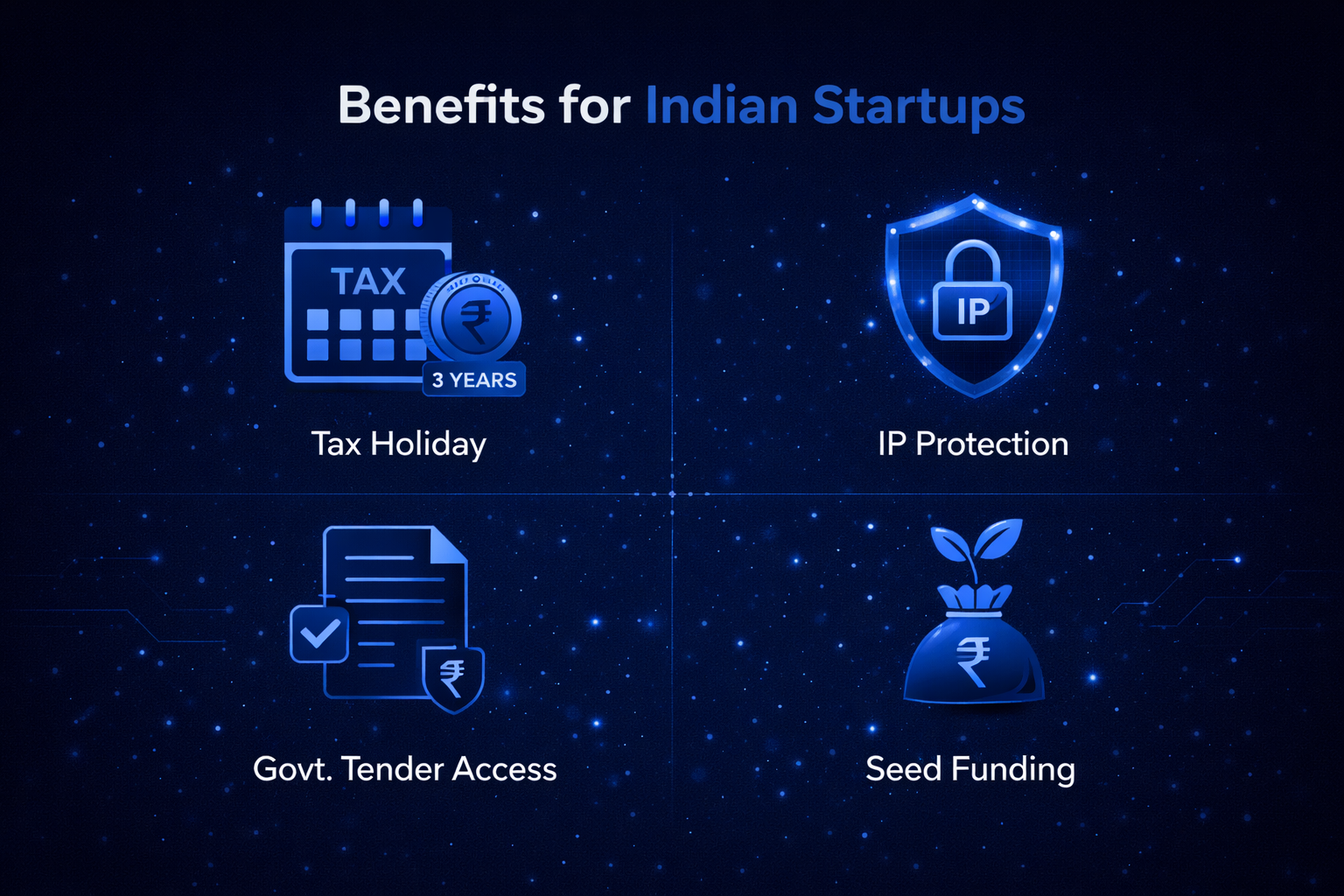
Recognition is a master key. Once you hold the DPIIT certificate, the following benefits become accessible without separate applications (except 80-IAC and seed funding, which require additional filings).
| Benefit | What It Covers | Additional Application Needed? |
|---|---|---|
| Section 80-IAC Tax Holiday | 100% income tax exemption on profits for 3 consecutive years | Yes — IMB certificate via Startup India portal |
| Angel Tax Exemption | Section 56(2)(viib) repealed from FY 2025-26 — no action required | No (as of FY 2025-26) |
| Self-Certification | Compliance self-certification for 6 labour laws and 3 environmental laws for up to 5 years | Register at Shram Suvidha Portal |
| IPR Fee Rebate | 80% rebate on patent fees; 50% on trademark fees via SIPP scheme | Apply via IP India facilitator |
| Government Procurement | Exemption from earnest money deposit, prior turnover and experience criteria in public tenders | Register on GeM as startup seller |
| SISFS Seed Funding | Up to ₹20 lakh grant (ideation stage) or up to ₹50 lakh debt (market entry stage) via registered incubators | Yes — apply through SISFS-registered incubator |
| Credit Guarantee | Collateral-free loans under the Credit Guarantee Scheme for Startups (CGSS) | Via eligible lending institutions |
8 Common Rejection Reasons and How to Avoid Them
The majority of DPIIT startup recognition rejections and 80-IAC denials stem from avoidable mistakes. Understanding these patterns before you apply saves weeks of delay and resubmission cycles.
- ✗Vague innovation description: “We provide services in the IT sector” is insufficient. Describe the specific problem, the technology or process innovation, and measurable impact on employment or wealth creation.
- ✗Wrong entity type: Sole proprietorships are ineligible. If you’re operating as a proprietorship, incorporate first — then apply. For 80-IAC, partnership firms are explicitly excluded.
- ✗Formed by splitting an existing business: Entities created by splitting or reconstructing an already-operational business do not qualify. Genuine new ventures incorporating for the first time have no issue here.
- ✗Missing or unverified documents: Submitting an unaudited balance sheet with turnover figures the financials don’t support is a fast track to rejection. Upload CA-certified statements for the 80-IAC application.
- !Weak pitch deck for 80-IAC: The IMB expects a clear problem-solution narrative, market size, business model, team credentials, and financial projections. A generic 5-slide deck will not clear the innovation bar.
- !Applying after the 10-year window closes: Recognition applications submitted after 10 years from incorporation are rejected outright. Check your incorporation date before applying.
Apply for DPIIT Recognition This Week
Validraft’s team handles the recognition application, 80-IAC document preparation, and IMB pitch deck — so your founders spend time building, not filing.
Get a Free Consultation → View All Registration Services9 Conclusion — Act Before the Financial Year Gets Away
Obtaining DPIIT startup recognition 2026 in April is a free, sub-72-hour process that immediately activates a layered set of government benefits. The most financially significant of these is the Section 80-IAC tax exemption startup framework — a 100% income tax holiday for 3 consecutive profitable years — but it requires a separate Inter-Ministerial Board application with a strong innovation narrative and complete financial documentation. Start that preparation now, not when your first profitable year arrives.
On angel tax: the question is settled for FY 2025-26 onward. Section 56(2)(viib) has been repealed. Startups raising capital this year and beyond are not subject to it. If you hold old DPIIT recognition from prior years and are raising a fresh round, you benefit from the repeal automatically — no new filings needed. Focus your legal and compliance bandwidth on the 80-IAC application instead.
For any startup incorporated from April 2016 onward that hasn’t yet applied — the Startup India registration in April 2026 is the highest-ROI 72 hours you can spend on government compliance. The certificate costs nothing, arrives in days, and keeps your options open for every benefit the Startup India Action Plan provides for the remainder of your eligibility window.
? Frequently Asked Questions
📎 Authoritative Sources
- → startupindia.gov.in — DPIIT Recognition & Tax Exemption Overview
- → startupindia.gov.in — Section 80-IAC Application Form
- → startupindia.gov.in — Startup India Scheme Overview
- → nsws.gov.in — National Single Window System (DPIIT Recognition Applications)
- → startupindia.gov.in — Inter-Ministerial Board Meeting Decisions
- → incometax.gov.in — Income Tax Act, 1961 (Section 80-IAC)
- → mca.gov.in — Ministry of Corporate Affairs (Incorporation)