
GST Registration for Freelancers in India: Complete Guide (2026)
The law does not care if you work from a high-rise corporate office or your living room couch. Under the Central Goods and Services Tax (CGST) Act, 2017, if you are providing professional services independently, you are a business entity. You are bound by the exact same statutory compliances as a multinational corporation.
A staggering number of independent professionals operate in the dark, relying on second-hand advice from forums or outdated portals. This exposes them to severe financial penalties. If you are reading this, you need the uncensored, strictly legal truth about GST Registration for Freelancers in India. No fluff, no jargon—just the exact legal framework governing your tax liabilities in 2026.
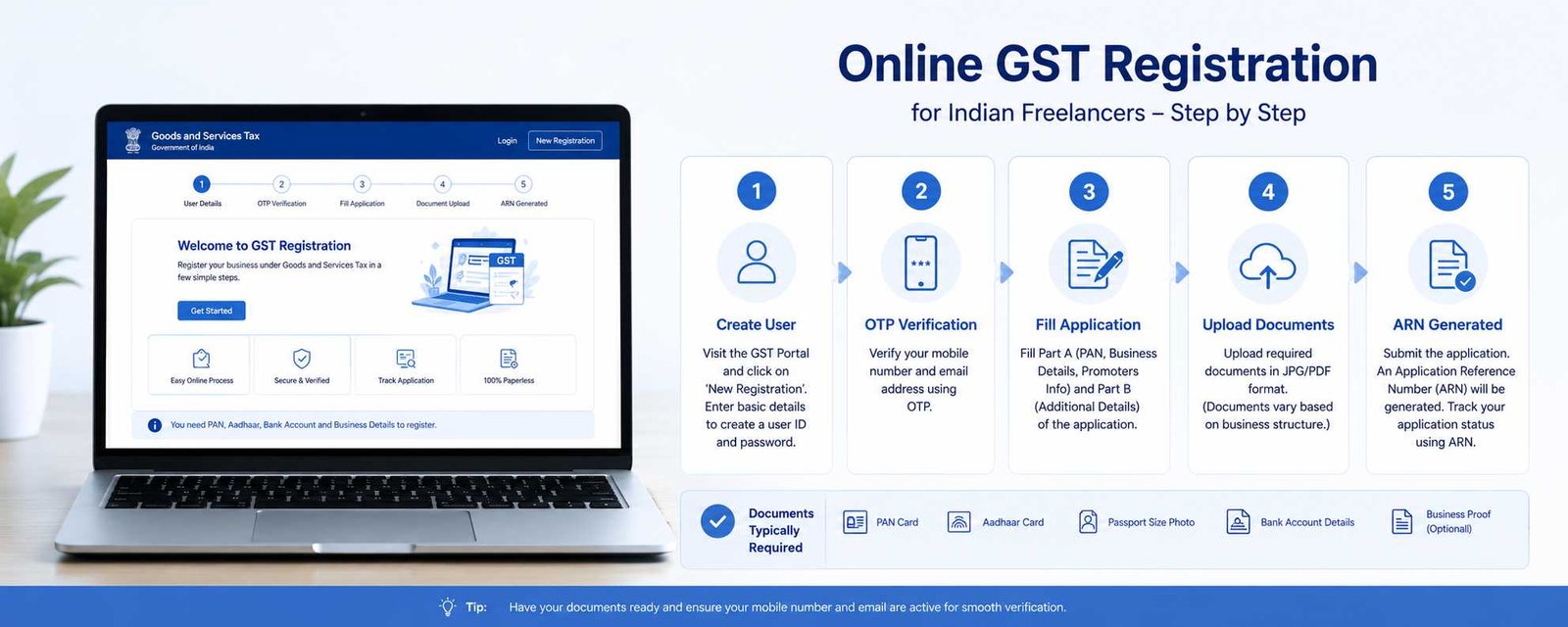
1. The Absolute Baseline: When is Freelancer GST Registration Mandatory?
The primary trigger for GST registration is your Aggregate Turnover. Section 22(1) of the CGST Act strictly defines when a supplier of services must obtain a 15-digit GSTIN.
| State Category | Applicable States | Mandatory Turnover Threshold (For Services) |
|---|---|---|
| Normal Category States | Maharashtra, Karnataka, Delhi, Gujarat, Tamil Nadu, and all other unlisted states. | ₹20 Lakhs in a Financial Year |
| Special Category States | Manipur, Mizoram, Nagaland, Tripura | ₹10 Lakhs in a Financial Year |
If your total receipts from all freelance platforms (Upwork, Fiverr, direct wire transfers, domestic bank deposits) breach the ₹20 Lakh (or ₹10 Lakh) mark, you have exactly 30 days to apply for GST for Freelancers. Failing to do so transitions your status from an independent professional to a tax evader.
2. The Inter-State Myth: Crushing Bad Legal Advice
Many misinformed accountants will tell you that the moment you provide a service to a client in another state, you must register for GST immediately, regardless of your turnover. This is factually incorrect for freelancers in 2026.
While Section 24 of the CGST Act does mandate compulsory registration for inter-state supplies, the Government issued Notification No. 10/2017-Integrated Tax. This explicit notification exempts service providers from compulsory registration for inter-state supplies, provided their aggregate turnover remains below the ₹20 Lakhs (or ₹10 Lakhs) threshold.
Bottom Line: Whether your client is in your city or across the country, as long as your total annual income is below ₹20 Lakhs, you are exempt from mandatory Freelancer GST Registration. Once you cross it, inter-state rules apply heavily.
3. Export of Services: Foreign Clients and The LUT Mandate
If you build software for a client in the USA or write copy for a firm in the UK, you are engaging in an “Export of Services.” Under the IGST Act, exports are treated as “Zero-Rated Supplies.” This means the effective tax rate is 0%. However, do not confuse a 0% tax rate with a 0% compliance requirement.
- Turnover Under ₹20 Lakhs: No registration required. You simply receive your foreign remittance.
- Turnover Over ₹20 Lakhs: Registration is strictly mandatory. You cannot simply ignore GST just because your clients are foreign.
Once registered, to legally bill a foreign client without adding 18% IGST to your invoice, you must file a Letter of Undertaking (LUT) in Form GST RFD-11 on the official GST Portal. By filing an LUT, you legally promise the government that you are exporting services and therefore should not be charged IGST out of pocket. Validraft routinely sets up LUT frameworks for high-earning independent consultants to protect their profit margins.
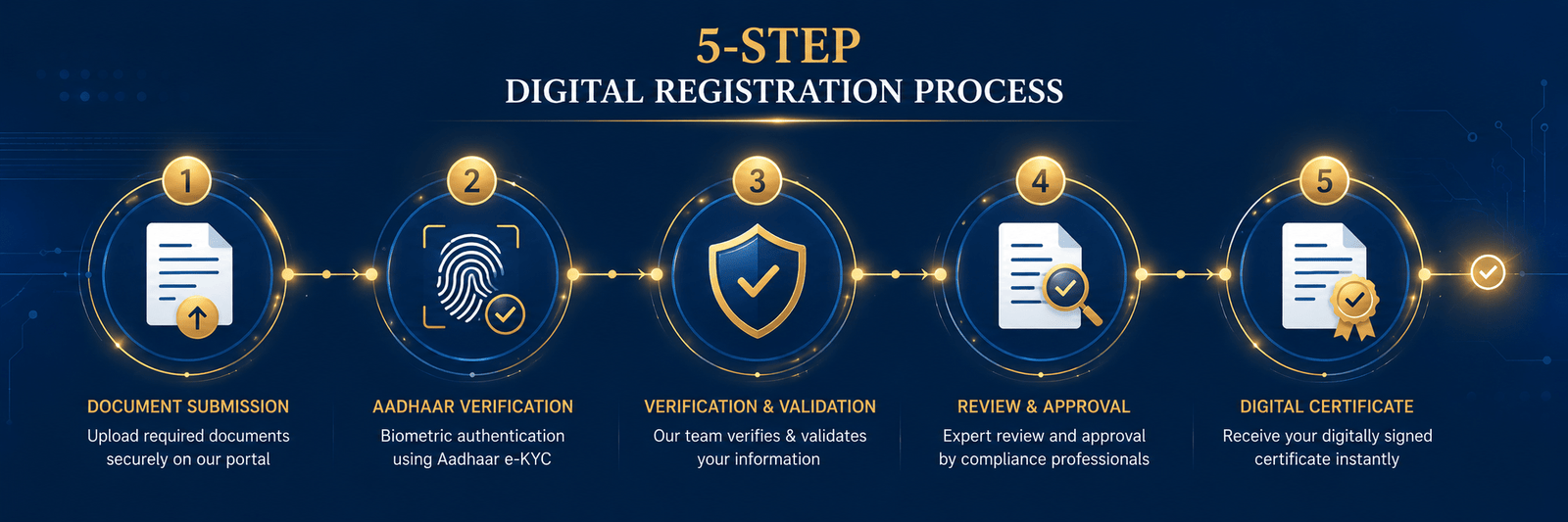
4. The Standard 18% Rate & The Composition Scheme Trap
If you cross the threshold and register, the standard GST rate applicable to nearly all professional freelance services (IT consultancy, web development, content writing, digital marketing) is 18%. This is billed under specific Service Accounting Codes (SAC), such as SAC 998312 for Business Consulting or SAC 998313 for IT Consulting.
You might read about the Composition Scheme for Service Providers (Section 10(2A)), which allows you to pay a flat 6% GST up to a ₹50 Lakh turnover. As a corporate lawyer, I strongly advise B2B freelancers against this. Here is why:
- You cannot issue a “Tax Invoice” and therefore cannot collect the 6% from your client. You pay it out of your own pocket.
- You cannot claim Input Tax Credit (ITC) on your business expenses (laptops, software, internet).
- You are strictly prohibited from making inter-state supplies or export of services.
For modern GST Registration for Freelancers, the Regular Scheme is the only logically and financially sound choice.
5. The Filing Mechanics: What Happens If You Ignore It?
Obtaining a GSTIN is not the end of the road; it is the beginning of a strict compliance framework. Registered freelancers must file Form GSTR-1 (reporting outward supplies) and Form GSTR-3B (paying the tax) either monthly or quarterly under the QRMP scheme, topped with an Annual Return in GSTR-9.
The Central Board of Indirect Taxes and Customs (CBIC) monitors bank accounts through PAN links. Your income is not invisible. Unreported professional income will inevitably trigger an automated notice from the tax authorities.
Do Not Gamble With Statutory Compliance
Ignorance of the law is not a legal defense in India. If you are approaching the ₹20 Lakh threshold or are already engaged in exporting services, you need a robust, error-free compliance architecture. Stop relying on patchwork advice.
At VALIDRAFT, our elite team of Chartered Accountants, Company Secretaries, and Corporate Lawyers handle end-to-end GST registrations, precise SAC code mapping, LUT filings, and monthly return processing for India’s top-earning freelancers.
Consult a VALIDRAFT Legal Expert Today