

GST Registration for Private Limited Company: Documents, Fees & Timeline

Starting a Private Limited Company is a massive achievement. But the moment your Certificate of Incorporation hits your inbox, the clock starts ticking on your tax compliance. The most critical legal hurdle? Getting your GST Registration for Company operations sorted.
We are not going to sugarcoat this. If you get your GST registration wrong, or if you delay it, the penalties are ruthless. Operating without a valid GSTIN when the law requires one can freeze your bank accounts and trigger heavy fines.
This guide gives you the unfiltered, raw truth about Company GST Registration in 2026. You will discover the exact legal triggers, the mandatory GST Registration Documents you must arrange, the real-world timeline, and the actual fees involved. No fluff. Just the law.
1. When is Company GST Registration Legally Mandatory?
Many founders think GST only applies when they hit massive revenue numbers. This is a dangerous myth. Under the CGST Act, your Private Limited Company must register under specific conditions.
The 2026 Turnover Thresholds (Section 22)
| Primary Business Activity | Threshold in Normal States | Threshold in Special Category States* |
|---|---|---|
| Exclusive Supply of Goods | ₹40 Lakhs | ₹20 Lakhs |
| Supply of Services (or Mixed) | ₹20 Lakhs | ₹10 Lakhs |
*Special Category States include Arunachal Pradesh, Assam, Jammu & Kashmir, Manipur, Meghalaya, Mizoram, Nagaland, Sikkim, Tripura, Himachal Pradesh, and Uttarakhand.
Immediate Triggers (Section 24)
Turnover limits do not protect everyone. You must secure your Company GST Registration from Day 1 if you do any of the following:
- Inter-State Sales: Selling a single rupee worth of goods across state borders.
- E-commerce Operations: Selling on platforms like Amazon, Flipkart, or Swiggy.
- Reverse Charge Mechanism (RCM): If you are liable to pay tax under RCM.
Select your company profile below to see if the law binds you to register immediately.
2. The Ultimate Checklist: GST Registration Documents
When you file Form GST REG-01 on the official Government GST portal, tax officers verify your data ruthlessly. A single typo or blurry document will trigger a Show Cause Notice (GST REG-03) and delay your launch by weeks.
Here are the exact GST Registration Documents a Private Limited Company must upload:
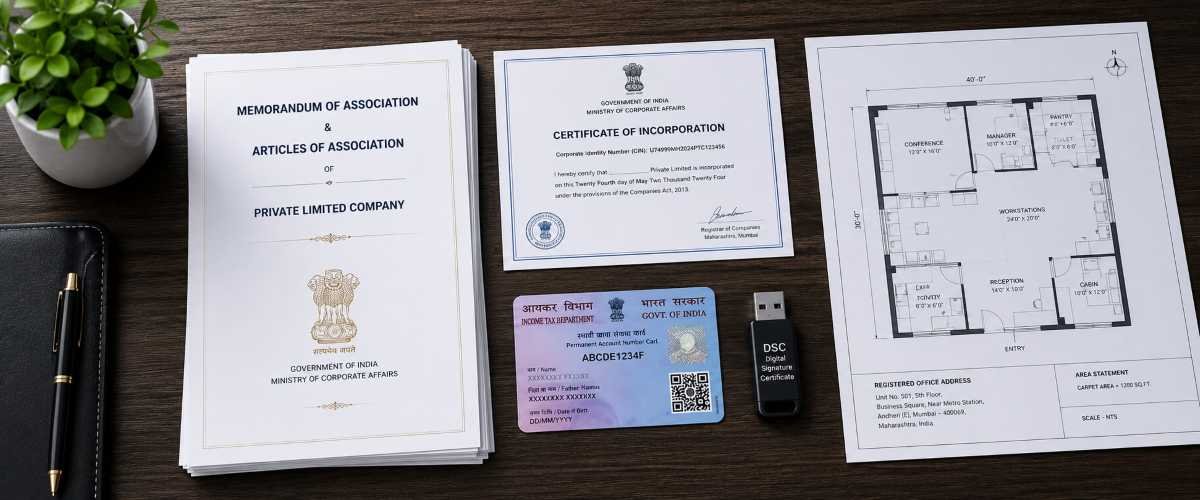
- Company PAN Card: The Permanent Account Number of your Private Limited Company. Expert Tip: Ensure your company’s PAN database details perfectly match any recent updates made under the newly implemented Income Tax Act 2025 (especially if you are handling concurrent compliance like provisional tax registrations via Form 104). Portal mismatches here guarantee instant application rejection.
- Certificate of Incorporation (COI): The official certificate issued by the Ministry of Corporate Affairs (MCA).
- MOA & AOA: The Memorandum and Articles of Association.
- Board Resolution: A legally drafted resolution signed by directors, officially appointing one individual as the Authorized Signatory.
- Director Identity Proofs: PAN and Aadhaar cards of all company directors and the Authorized Signatory.
- Authorized Signatory Photo: A clear passport-sized photograph (JPEG format, max 100KB).
- Principal Place of Business Proof:
If Owned: Latest property tax receipt or registry copy.
If Rented/Virtual: Rent Agreement PLUS a No Objection Certificate (NOC) from the legal owner, PLUS the latest electricity bill (not older than 2 months). The officer will verify the address meticulously. - Company Bank Account Proof: A clearly scanned canceled cheque or the first page of the latest bank statement showing the company name.
- Digital Signature Certificate (DSC): A valid Class 3 DSC of the Authorized Signatory. Companies cannot verify GST applications using an SMS OTP. You must legally sign it with a DSC.
3. The Honest Truth About GST Fees : GST Registration for Private Limited Company
Let’s cut through the internet noise regarding fees. The reality is two-fold:
- Government Fees: ₹0. The Indian Government does not charge a single rupee to submit Form REG-01 on the portal.
- Compliance & Real-World Costs: Trying to file this yourself without a legal background is a trap. You will spend money obtaining a Class 3 DSC (₹1,500 – ₹2,500). Furthermore, selecting the wrong HSN/SAC codes or failing to respond to a REG-03 notice legally can result in permanent rejection. Hiring a seasoned CA or Corporate Lawyer to handle your Company GST Registration flawlessly typically costs between ₹2,000 and ₹5,000. It is a minor investment to secure your business’s legal foundation.
4. Standard Operating Procedure (SOP) & Timeline
How fast can you legally begin issuing tax invoices? Processing your Company GST Registration follows a strict timeline:
- Day 1: You submit Form GST REG-01 with all correct documents and authenticate via Aadhaar. You receive an Application Reference Number (ARN).
- Day 3 to Day 7: (Best Case Scenario) The GST Officer reviews your file. If your documents are flawless, they approve it. You receive Form GST REG-06, which contains your 15-digit GSTIN and Registration Certificate.
- Notice Issued: If the officer spots a discrepancy, they issue Form GST REG-03. You legally have 7 working days to reply via Form GST REG-04. This pushes your timeline to 15-21 days.
- Physical Verification: If your Aadhaar authentication fails or the risk system flags your address, the officer will mandate a physical site visit. Expect a delay of 30+ days.
Don’t Risk Rejection. Get It Done Right.
A rejected GST application leaves a permanent mark on your company’s compliance record. Let the elite corporate attorneys and compliance experts at Validraft handle the heavy lifting while you focus on scaling your business.
Start Your GST Registration with Validraft