

GST Registration Documents for Proprietorship Business: Complete Checklist
A straightforward, legally absolute breakdown of the mandatory paperwork you need to secure your GSTIN without face-saving tax officer rejections.
In India, a sole proprietorship has no independent legal status distinct from its owner. Legally, you and your business are one and the same entity. Consequently, when setting up a new tax profile, the Proprietorship GST Registration process relies entirely on your personal Know Your Customer (KYC) details and physical proof of where you do business.
Filing your application on the official GST Portal requires zero government fees. However, uploading blurry scans, using expired contracts, or submitting mismatched names will cause the tax officer to instantly freeze your application with a Show Cause Notice (SCN). This guide covers the exact, mandatory GST Registration Documents you must arrange before clicking submit.
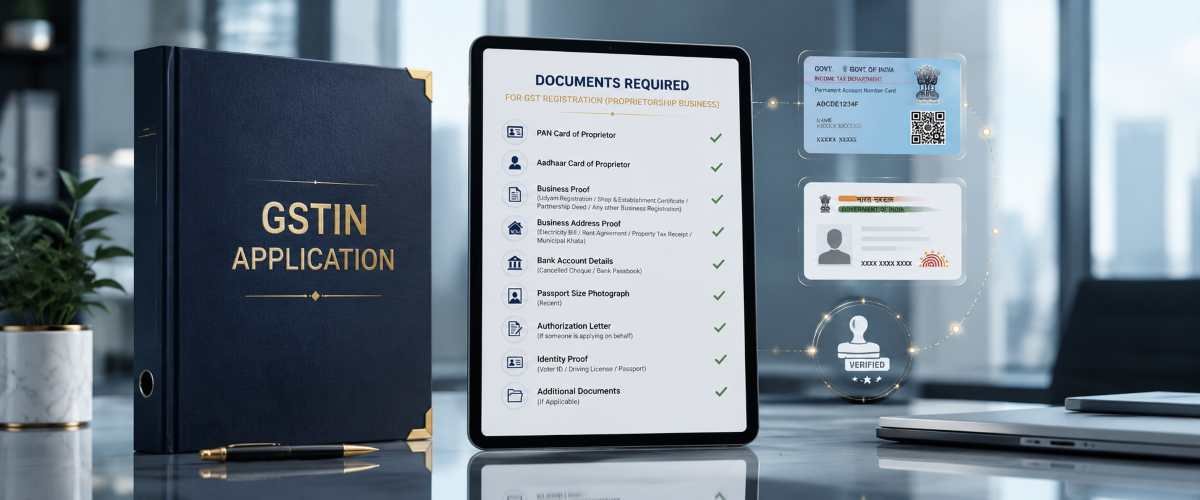
1. Personal KYC: GST Registration Documents
Your personal identity files form the foundation of the Goods and Services Tax Identification Number (GSTIN). Every single letter on these documents must match your tax profile perfectly.
| Document Name | Filing Requirements & Specifications | Portal File Rule |
|---|---|---|
| PAN Card of the Proprietor | The business uses the owner’s personal Permanent Account Number. Your 15-digit GSTIN will directly embed this PAN. Must be active and valid. | PDF or JPEG Max 1 MB |
| Aadhaar Card | Essential for the mandatory Aadhaar Authentication phase. Ensure your mobile number is currently linked to your Aadhaar to receive secure OTPs. | PDF or JPEG Max 1 MB |
| Passport Size Photograph | A recent, front-facing color photograph of the sole proprietor taken against a clear background. No hats or sunglasses. | JPEG format only Max 100 KB |
2. Proof of Principal Place of Business
The highest volume of application rejections by Central and State tax authorities stems from improper business address filings. You must submit specific documents based entirely on how you possess the property.
Scenario A: You Own the Business Premises
If the office, shop, or home from which you operate belongs to you legally, provide any one of the following instruments:
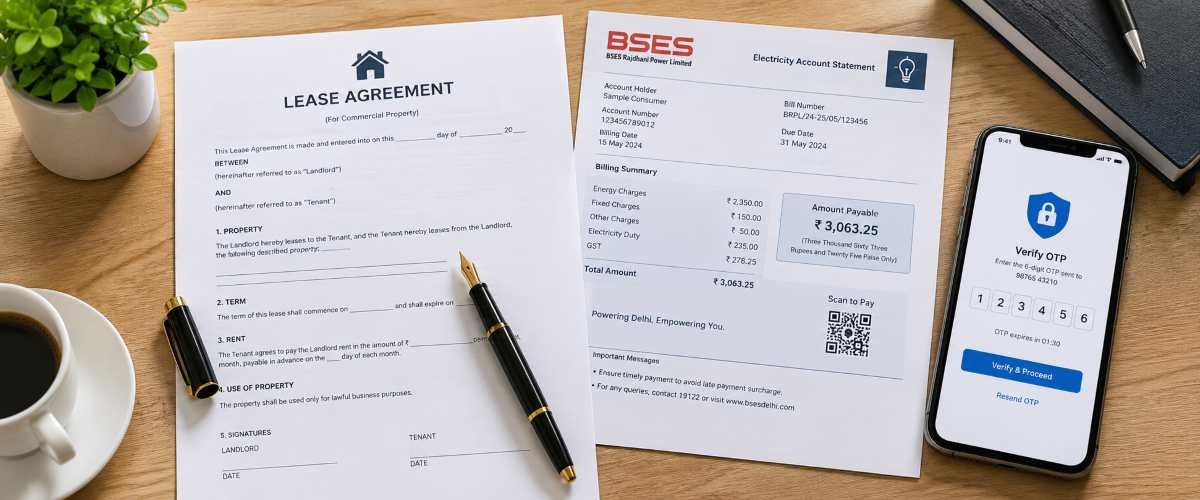
- The latest Electricity Bill or Water Bill (not older than 2 consecutive months).
- The most recent Property Tax Receipt or Municipal Khata copy.
- A registered Legal Ownership Deed (Registry copy).
Scenario B: The Property is Rented or Leased
If you are operating out of a rented facility, shop, or commercial workspace, the portal expects proof of tenancy and proof of the landlord’s authority over the asset:
- A valid, active Rent / Lease Agreement signed by both parties.
- The landlord’s latest utility bill (Electricity Bill or Property Tax Receipt) to verify the property’s structural details.
Scenario C: Shared Spaces or Family-Owned Properties (Consent Basis)
If you run your business from a residential home owned by your parents, spouse, or relatives without paying formal rent, you must supply:
- A written Consent Letter / No Objection Certificate (NOC) signed by the legal owner on plain paper, granting you permission to execute business tasks there.
- The legal owner’s latest Electricity Bill or Property Tax Receipt.
3. Bank Account Evidence
The portal verifies that your business operations are tied to a real, functioning financial account. To fulfill this condition, prepare a digital scan of:
- The first page of your bank passbook, or a recent account statement containing your full legal name, account number, MICR code, IFSC code, and branch details.
- Alternatively, a clear, cancelled cheque with your full name custom-printed directly on the surface.
You can legally upload your personal savings bank account details during the initial setup phase. However, once your formal GSTIN is approved, commercial compliance standards dictate that you transition immediately to a dedicated business current account.
Summary Checklist for Online Upload
Before initiating your registration form on the portal, double-check that every digital file is optimized to the following technical benchmarks:
- Proprietor Photograph: JPEG format only, file size between 10 KB and 100 KB.
- Identity Proofs (PAN, Aadhaar): PDF or JPEG format, maximum file size capped at 1 MB.
- Business Address Evidence: PDF or JPEG format, maximum file size strictly limited to 1 MB (Ensure all text, seals, and signatures are completely legible).