
Voluntary GST Registration:
Why Smart Businesses Register Before the Limit
The ₹40L/₹20L threshold exists to protect small businesses — not to hold them back. A voluntary GST registration below the turnover limit unlocks ITC savings, e-commerce access, and the B2B credibility that early-stage companies need most.
Goods threshold
(regular states)
Services threshold
(regular states)
Standard approval
(Aadhaar auth)
Govt fee for
GST registration

- No government fee — GST registration is free. The process runs entirely online at gst.gov.in and takes 7 working days for Aadhaar-authenticated standard applications.
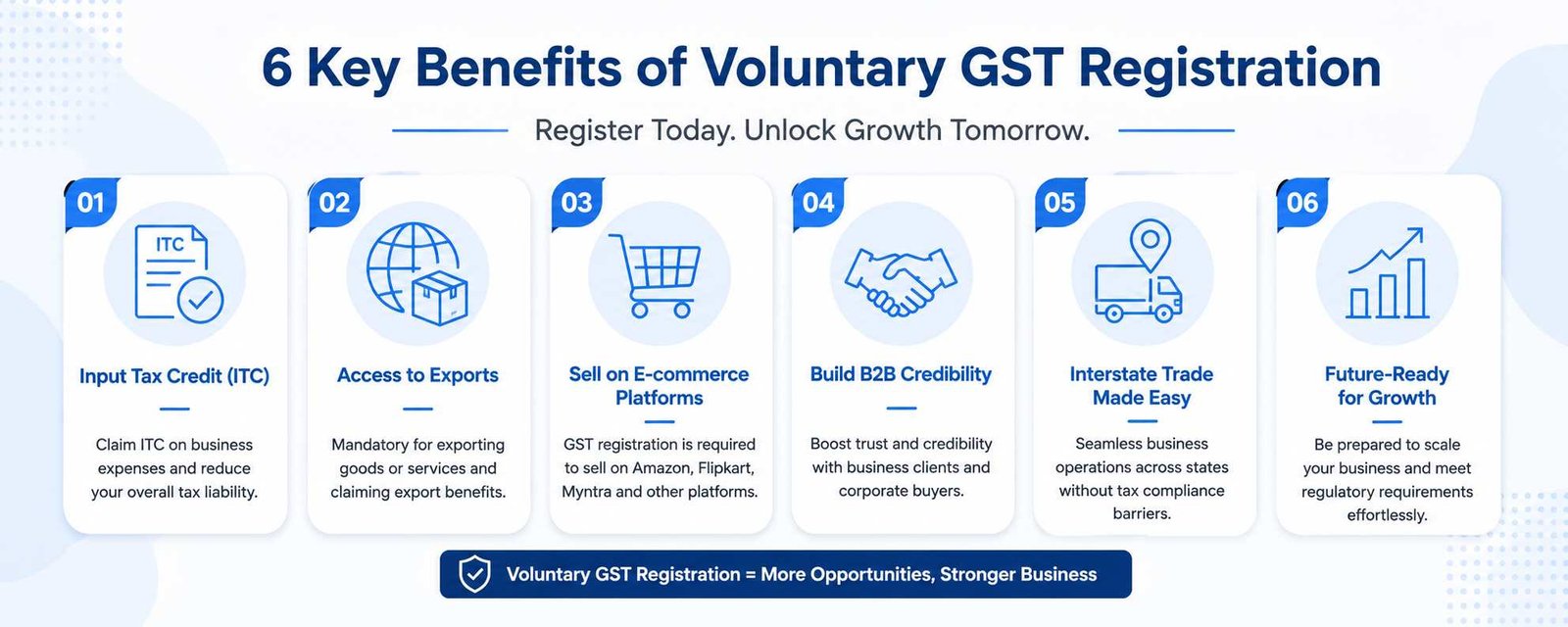
- ITC unlocked immediately — once registered, GST paid on purchases (rent, software, equipment, professional fees) becomes creditable input tax credit, directly reducing your tax outflow.
- E-commerce sellers must register regardless of turnover — selling on any aggregator platform (Section 9(5) categories via e-commerce operators) requires GST registration from the first rupee of sales.
- B2B clients need your GSTIN — without a GST registration, your corporate buyers cannot claim ITC on purchases from you, making you commercially uncompetitive in B2B markets.
- One-year lock-in no longer applies — the earlier restriction that barred cancellation of voluntary GST registration for 12 months has been removed. You can apply for cancellation via Form GST REG-16 if circumstances change.
Most business owners think about GST registration only when the turnover clock ticks past ₹40 lakh for goods or ₹20 lakh for services. That’s the threshold under Section 22 of the CGST Act, 2017 — and breaching it triggers mandatory registration. But voluntary GST registration, available under Section 25(3) of the CGST Act, lets any business opt in before hitting that limit. For a large segment of early-stage businesses, freelancers, and service providers operating below the turnover limit, voluntary registration isn’t just a tax formality — it’s a strategic growth decision.
This guide covers every material benefit of GST registration below the turnover limit, the business profiles for whom it makes clear financial sense, the compliance obligations that come with it, and the step-by-step registration process on the GST portal — updated for the position as on 06 May 2026.
1 What Is Voluntary GST Registration and What Law Governs It
Voluntary GST registration is the act of registering under the Goods and Services Tax regime before your aggregate turnover crosses the mandatory threshold. It is governed by Section 25(3) of the CGST Act, 2017, which permits any person — even those not otherwise required to register — to obtain a GSTIN by filing Form GST REG-01 on the official portal.
Once registered voluntarily, the business is treated in exactly the same manner as a mandatorily registered taxpayer. It must charge GST on taxable supplies, issue GST-compliant tax invoices under Section 31, file the applicable returns (GSTR-1, GSTR-3B), and comply with all provisions of the CGST Act. There is no separate “voluntary registration” category on the portal — you obtain a standard GSTIN. The distinction exists only in the legal basis of registration, not in the rights and obligations that follow.
2 Current GST Registration Turnover Thresholds (2026)
Before evaluating voluntary GST registration, it’s important to confirm whether your business actually falls below the mandatory threshold. The thresholds in effect as on 06 May 2026 are as follows:
| Business Type | Regular States | Special Category States |
|---|---|---|
| Goods supplier | ₹40 lakh | ₹20 lakh |
| Service provider | ₹20 lakh | ₹10 lakh |
| Mixed supply (goods + services) | ₹20 lakh | ₹10 lakh |
| E-commerce seller (all goods) | Mandatory from ₹1 (intra-state, small eligible sellers may be exempt) | Mandatory from ₹1 |
| Inter-state goods supplier | Mandatory regardless of turnover | Mandatory regardless of turnover |
Thresholds unchanged as confirmed by the GST Council. Source: Section 22, CGST Act 2017. Verify at gst.gov.in. Last verified: May 2026.
Special category states include Manipur, Mizoram, Nagaland, Tripura, Meghalaya, Sikkim, Arunachal Pradesh, Uttarakhand, and Himachal Pradesh. If your turnover falls below the applicable threshold and none of the Section 24 mandatory registration categories apply, voluntary GST registration is entirely at your discretion.
3 The 6 Business Benefits of Voluntary GST Registration
Voluntary GST registration below the turnover limit delivers concrete, measurable advantages. The six most significant are detailed here — along with who benefits most from each.
4 Who Should Get Voluntary GST Registration: Business Profiles
Not every business below the threshold benefits equally from voluntary GST registration. The decision depends on your client mix, cost structure, and growth trajectory. Below are the business profiles for whom the case is clear-cut.
✅ Strong case for voluntary registration
- Freelancers and consultants with B2B clients (corporate buyers, agencies, funded startups)
- Any business selling on Amazon, Flipkart, Meesho, or other e-commerce aggregators
- Exporters of goods or services billing foreign clients in convertible currency
- Service providers who purchase significant business inputs (software, rent, equipment) and want to reclaim the GST paid
- Businesses that supply across state lines even at low turnover
- Startups expecting to cross the threshold within 6–12 months
- Businesses participating in government tenders or corporate vendor panels
⚠️ Weigh carefully before registering
- Purely B2C businesses (end consumers cannot claim ITC, so unregistered status doesn’t affect their purchasing decision)
- Businesses with no GST-able input purchases — ITC benefit is nil
- Businesses supplying exempt goods or services where GST cannot be charged regardless
- Cash-flow-constrained micro businesses where monthly return filing is a burden without commensurate benefit
- Agriculturists supplying produce from cultivation — exempt under Section 23
5 ITC Benefit Explained: What You Can and Cannot Claim
Input tax credit is the single most quantifiable financial benefit of voluntary GST registration for businesses below the turnover limit. ITC under Section 16 of the CGST Act allows a registered person to deduct GST paid on business inputs from the GST collected on outputs — you pay only the net difference to the government.
ITC-eligible expenses after voluntary GST registration:
- ✓Office rent: GST paid on commercial lease rentals is creditable as ITC, provided the premises are used for business purposes and the landlord has charged GST.
- ✓Software subscriptions: SaaS tools, accounting software, project management tools — GST at 18% on these is fully claimable as ITC.
- ✓Professional and legal fees: CA fees, legal advisory charges, consultant fees — GST paid to registered service providers is creditable.
- ✓Office equipment and computers: GST on capital goods (laptops, servers, printers) used in the course of business is creditable as capital goods ITC.
- ✓Raw materials and trading stock: For businesses dealing in goods, GST on purchases from registered suppliers is the primary ITC pool.
- ✓Internet and telecom services: Business internet and mobile connections are eligible for ITC where used for furtherance of business.
- !Motor vehicle purchases: Generally blocked under Section 17(5) unless used for transport of goods, passengers, training, or testing — confirm applicability to your business type.
- ✗Food, beverages, and employee benefits: Blocked credit under Section 17(5) of the CGST Act — not claimable as ITC regardless of business purpose.
- ✗Personal expenses: Any GST paid on non-business items cannot be claimed as ITC — the “course or furtherance of business” test applies to every claim.
To claim ITC, the purchase must appear in your GSTR-2B (auto-populated from the supplier’s GSTR-1), the supplier must have filed their return, and you must hold a valid tax invoice. The ITC reconciliation requirement means choosing registered vendors matters more once you are voluntarily registered.
6 E-Commerce Sellers and Voluntary GST Registration: The Mandatory Reality
For e-commerce sellers, the voluntary vs. mandatory distinction is practically irrelevant — registration is required regardless of turnover under Section 24 of the CGST Act. Every person who supplies goods or services through an electronic commerce operator (ECO) — Amazon Seller Central, Flipkart Seller Hub, Meesho, Nykaa, etc. — must be registered under GST before making a single sale.
The only partial relief applies to service providers whose supplies fall under the categories specified in Section 9(5) — where the ECO collects and deposits tax on behalf of the supplier. Even in these cases, the underlying compliance architecture requires a GSTIN for onboarding and invoicing.
Ready to Get Your Voluntary GST Registration?
Validraft handles the complete GST REG-01 filing, document preparation, and portal submission — GSTIN in 7 working days.
Start Registration → View GST Services7 How to Apply for Voluntary GST Registration: Step-by-Step (2026)
The GST registration process is fully online. No physical visit to a GST office is required for standard applications. The process follows the framework updated by CBIC Instruction No. 03/2025-GST (issued 17 April 2025), which standardises document requirements and prohibits officers from demanding documents beyond the Form REG-01 prescribed list.
8 Documents Required for Voluntary GST Registration (Form REG-01)
CBIC Instruction No. 03/2025-GST explicitly restricts officers to requesting only documents listed in Form REG-01. The document requirement varies by business constitution. The table below covers the most common entity types applicable to voluntary GST registration scenarios.
| Document Category | Sole Proprietor | Partnership / LLP | Private Limited Company |
|---|---|---|---|
| PAN | Proprietor’s PAN | Firm / LLP PAN | Company PAN |
| Aadhaar | Proprietor’s Aadhaar | Authorised partner’s Aadhaar | Authorised signatory’s Aadhaar |
| Business address proof (owned) | Any one: latest electricity bill, property tax receipt, or municipal khata copy | ||
| Business address proof (rented — registered lease) | Registered rent agreement + any one ownership proof of lessor | ||
| Business address proof (rented — unregistered lease) | Rent agreement + ownership proof of lessor + lessor’s identity proof | ||
| Constitution proof | No separate document required | Partnership deed / LLP Agreement + Certificate of Incorporation (LLP) | Certificate of Incorporation + MoA & AoA |
| Bank account | Cancelled cheque or bank statement showing account number, IFSC, and entity name — submit within 30 days of GSTIN allotment | ||
| Photograph | Proprietor’s photo | All partners’ photos | Authorised signatory’s photo |
| Signing method | EVC / e-Sign / DSC | EVC / e-Sign / DSC | Class 3 DSC (mandatory) |
Document requirements as per Form GST REG-01 and CBIC Instruction No. 03/2025-GST (F. No. CBIC-20016/24/2025-GST, April 2025). Officers cannot demand MSME certificates, trade licences, or additional KYC of landlords beyond the above. Verify at gst.gov.in.
9 Compliance Obligations After Voluntary GST Registration
Voluntary GST registration below the turnover limit carries the same compliance obligations as mandatory registration. These are not optional — non-filing of returns after registration triggers late fees, interest, and can result in cancellation of your GSTIN.
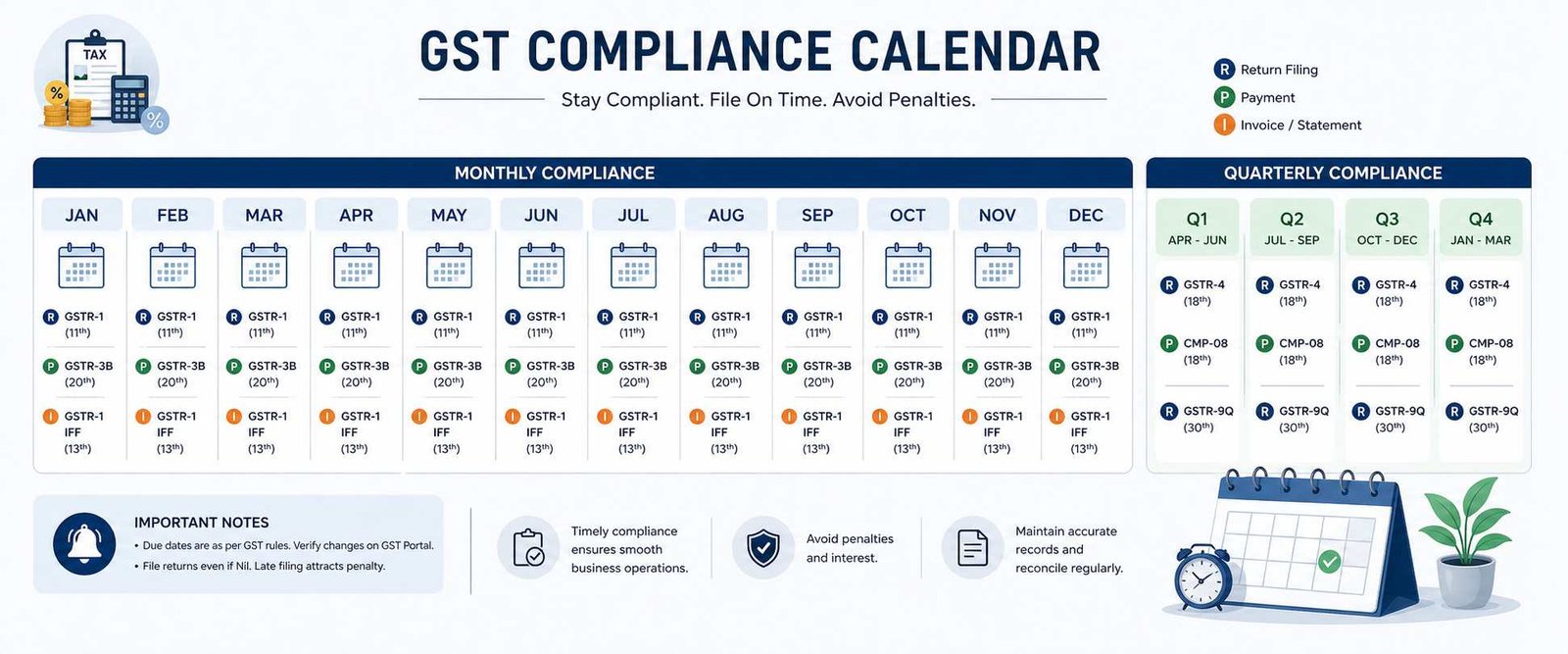
| Return / Compliance | Frequency | Applicable To | Late Fee (per day) |
|---|---|---|---|
| GSTR-1 (outward supplies) | Monthly (11th) or Quarterly (13th of quarter-end month via QRMP) | All regular taxpayers | ₹50/day (₹20/day for nil returns) |
| GSTR-3B (summary + tax payment) | Monthly (20th) or Quarterly (22nd/24th under QRMP) | All regular taxpayers | ₹50/day (₹20/day for nil returns) + 18% p.a. interest on tax |
| GSTR-9 (annual return) | Annual (31 December following FY end) | Turnover > ₹2 crore (optional below) | ₹200/day (capped at 0.25% of turnover) |
| Bank details submission | Within 30 days of GSTIN allotment | All registered persons (GSTN Advisory, Nov 2025) | Registration suspended; returns, ITC, and e-invoicing blocked |
| LUT renewal (exporters) | Annual (Form GST RFD-11 before 1 April each year) | Registered exporters supplying without IGST payment | Must pay IGST on exports if LUT lapses |
Businesses with aggregate turnover up to ₹5 crore can opt for the QRMP (Quarterly Return and Monthly Payment) scheme, reducing GSTR-1 and GSTR-3B filing to quarterly frequency while still making monthly tax payments via PMT-06. This significantly reduces the compliance burden for voluntarily registered small businesses.
Get Your Voluntary GST Registration Done Right
Validraft prepares your REG-01, handles document verification, and gets your GSTIN — no portal errors, no officer queries.
Get Started Today → View GST Services10 Is Voluntary GST Registration Worth It for Your Business?
Voluntary GST registration below the turnover limit is worth it when the financial upside — primarily ITC recovery and expanded market access — outweighs the compliance overhead of monthly return filing. For businesses with significant input purchases, B2B client dependencies, e-commerce ambitions, or export revenue, the calculation almost always favours early registration. The government fee is zero, the process is fully online under a streamlined framework, and the commercial benefits begin the moment your GSTIN is allotted.
The businesses that should pause before registering are purely B2C operations with minimal input GST, businesses supplying only exempt goods or services, and micro-enterprises where the compliance time cost is genuinely disproportionate to the ITC benefit. For everyone else — particularly startups, consultants, digital service providers, and product businesses eyeing organised retail or export — voluntary GST registration is not just permissible but commercially logical.
As a voluntarily registered person under Section 25(3) of the CGST Act, you enter the same compliance ecosystem as every other registered taxpayer in India. That ecosystem — monthly GSTR-1 and GSTR-3B filings, ITC reconciliation, and compliant invoicing — is manageable with the right systems in place. What it delivers in return is access to the formal B2B economy, ITC savings on every business purchase, and the credibility that a GSTIN signals to every counterparty you deal with.
11 Frequently Asked Questions: Voluntary GST Registration Below the Limit
Yes. Under Section 25(3) of the CGST Act, 2017, any person — including freelancers and independent consultants — can register voluntarily even if their aggregate turnover is below the ₹20 lakh (or ₹10 lakh in special category states) threshold. The process involves filing Form GST REG-01 at gst.gov.in. Once registered, the freelancer is treated as a regular registered taxpayer — GSTR-1 and GSTR-3B must be filed monthly or quarterly, and GST must be charged on all taxable service supplies. The benefit is the ability to claim ITC on business expenses (software, internet, rent) and to issue GST invoices to B2B clients who require them for their own ITC claims.
Yes — once voluntarily registered, you must charge GST on all taxable supplies, including sales to end consumers (B2C). For B2C businesses, this means the sale price increases by the applicable GST rate unless you absorb it in your margin. B2C consumers cannot claim ITC, so GST increases their effective cost. This is why the voluntary registration decision for purely B2C businesses requires careful analysis of pricing impact versus ITC savings on the cost side. B2B buyers, on the other hand, are indifferent to GST on your invoice (since they reclaim it as ITC) — and in fact, prefer it.
For most goods sellers on aggregator platforms (Amazon, Flipkart, Meesho), GST registration is mandatory under Section 24(ix) of the CGST Act — regardless of turnover. The turnover exemption under Section 22 does not apply. There is a limited exception for eligible intra-state goods sellers whose supplies fall within Section 9(5) categories (where the ECO deposits tax on their behalf), but this requires specific conditions to be met. For services supplied through e-commerce platforms, some categories are covered under Section 9(5) with the ECO paying the tax. Always verify current applicability at gst.gov.in before assuming exemption.
Yes, with specific conditions. Section 18(1) of the CGST Act allows a voluntarily registered person to claim ITC on inputs held in stock on the date immediately preceding the date of grant of registration — provided those inputs are used for taxable supplies and the ITC claim is made within the time limit specified in Section 18(2). For inputs held in stock: claim in the first GSTR-3B after registration. For capital goods held in stock: reduced by 5% per quarter (or part thereof) from the invoice date. The claim must be filed in Form GST ITC-01 within 30 days of the date of grant of registration. Maintaining invoice records for all pre-registration business purchases is therefore important before applying.
Under Section 122 of the CGST Act, 2017, a person who is required to register but fails to do so faces a penalty of ₹10,000 or the amount of tax evaded, whichever is higher. Additionally, all supplies made during the period of non-registration are taxable, and the unregistered person is liable to pay the accumulated GST with interest at 18% per annum. Tax authorities are increasingly using UPI transaction data to identify traders who cross registration thresholds but haven’t registered — this enforcement risk has increased in 2025–26. Voluntary registration before the threshold eliminates this risk entirely.
Yes. The earlier one-year restriction on cancellation of voluntary GST registration has been removed. You can apply for cancellation of a voluntary GST registration using Form GST REG-16 on gst.gov.in at any time after registration. However, all pending returns must be filed, all GST liabilities (tax, interest, late fees) must be cleared, and you may be required to reverse any ITC claimed on inputs in stock at the time of cancellation. The proper officer will process the cancellation and issue Form GST REG-19 (cancellation order) after verifying compliance. Note that cancellation due to non-filing of returns requires all returns to be filed first — revocation of cancellation cannot be applied for until this condition is met.