

OPC vs Private Limited Company in 2026

OPC vs Private Limited Company in 2026:
Which Is Right for Solo Founders?
A compliance, tax, and funding comparison to help solo founders pick the right corporate structure from day one — so you don’t pay to convert later.
Minimum Capital
Required (Both)
Typical Incorporation
Timeline (SPICe+)
Member Needed
for OPC
Corporate Tax Rate
(Sec. 115BAA)
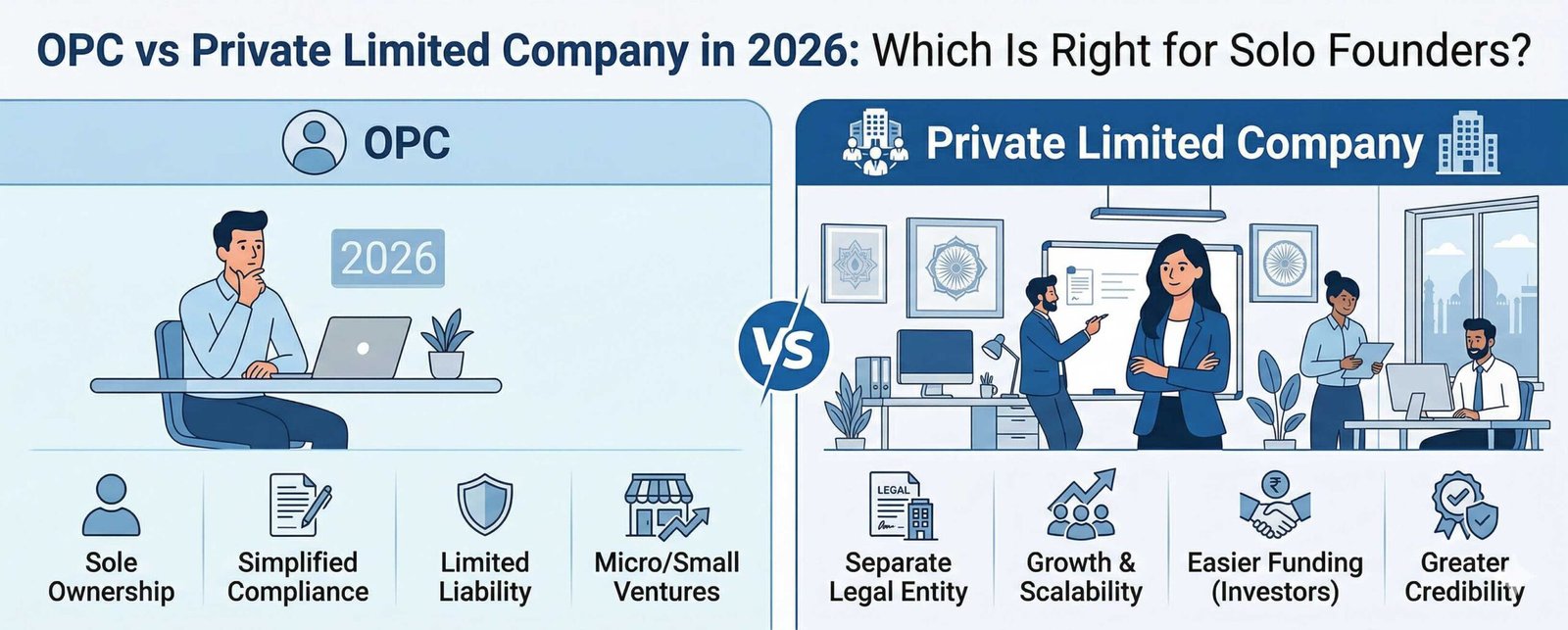
- No mandatory conversion threshold — the old ₹2 crore turnover / ₹50 lakh capital rule forcing OPCs to convert was removed in April 2021. OPCs can scale indefinitely. Verify at mca.gov.in.
- OPC registration is for Indian citizens only — foreign nationals and NRIs (unless resident 120+ days in India) cannot incorporate an OPC. A Pvt Ltd has no such citizenship restriction.
- Tax rates are equal at 22% (plus surcharge and cess = ~25.17%) under Section 115BAA for both structures — but only Pvt Ltd companies registered under DPIIT Startup India qualify for the 100% tax exemption under Section 80-IAC.
- OPCs cannot raise equity funding — VCs, angel investors, and ESOPs are not available to OPCs. Solo founders who plan to raise external capital should register as a Pvt Ltd from day one.
- Annual compliance is lighter for OPC — no AGM, half-yearly board meetings instead of quarterly, and a simplified MGT-7A annual return. Pvt Ltd carries full AGM and quarterly board meeting obligations.
For a solo founder in India, the choice between OPC vs Private Limited Company is one of the first — and most consequential — legal decisions you’ll make. Both structures are governed by the Companies Act 2013, both provide limited liability, and both are incorporated through MCA’s SPICe+ portal. But they serve fundamentally different founder profiles. OPC registration gives a single individual full control within a lean corporate structure. A Private Limited Company opens the door to investors, co-founders, and faster scaling — at a higher compliance cost.
This article breaks down the OPC vs Private Limited Company decision across ownership, compliance, taxation, and funding — so you can choose the right structure for your one person company in India, not the most popular one.
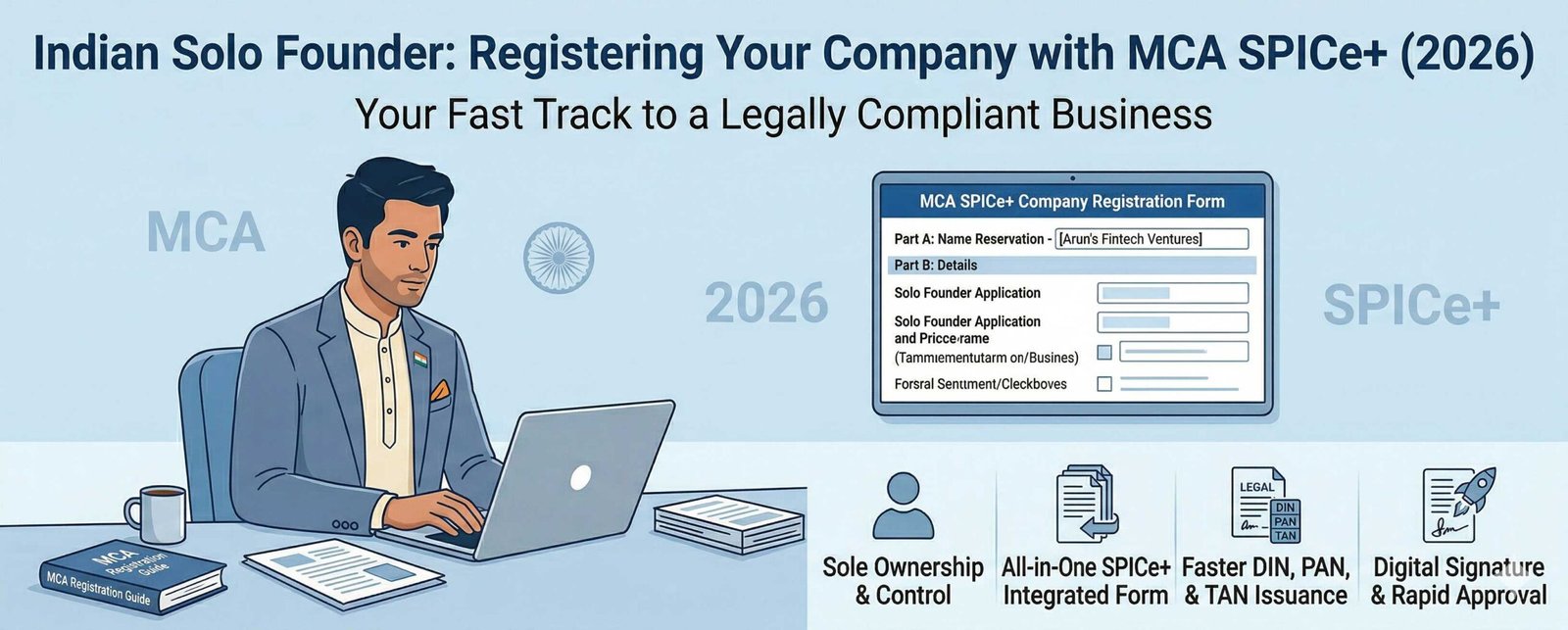
1 What Is an OPC? The One Person Company Explained
A One Person Company (OPC) is defined under Section 2(62) of the Companies Act, 2013 as a company with only one member. It was introduced to bring the benefit of corporate structure to solo entrepreneurs who previously had to operate either as sole proprietors (unlimited liability) or form a Pvt Ltd with a nominal second shareholder.
With OPC registration, the sole member is also the sole director and sole shareholder — but the company is a separate legal entity. Personal assets are ring-fenced from business liabilities. Creditors can pursue the OPC’s assets, not the founder’s personal savings, home, or investments.
2 What Is a Private Limited Company?
A Private Limited Company is governed by Section 2(68) of the Companies Act, 2013 and requires a minimum of two directors and two shareholders. It’s the most common corporate structure for funded startups, product businesses, and any venture planning equity-based financing. Shares can be transferred privately, which makes it compatible with ESOPs, venture capital, and angel investments.
A Pvt Ltd has no cap on paid-up capital or turnover, can have up to 200 shareholders, and is the preferred structure for institutional investors. The compliance burden is meaningfully higher — quarterly board meetings, a mandatory AGM, and a longer annual return (MGT-7) — but the trade-off is full capital-raising capability from day one.
3 OPC vs Private Limited Company — Full Comparison Table
| Parameter | OPC (One Person Company) | Private Limited Company |
|---|---|---|
| Governing Section | Section 2(62), Companies Act 2013 | Section 2(68), Companies Act 2013 |
| Min. Members | 1 (+ mandatory nominee) | 2 shareholders, 2 directors |
| Max. Members | 1 | 200 |
| Eligibility | Indian citizen, resident 120+ days in preceding FY | Any individual or entity; foreign nationals allowed |
| Min. Capital | ₹0 (no statutory minimum) | ₹0 (no statutory minimum) |
| AGM Requirement | Not required | Mandatory every year |
| Board Meetings | 1 per half-year (90-day gap) | Min. 4 per year (quarterly) |
| Annual Return | MGT-7A (simplified) | MGT-7 (full) |
| Financial Statements | AOC-4 — within 180 days of FY end | AOC-4 — within 30 days of AGM |
| Equity Funding | Not possible (no equity investors) | Fully supported (VC, angels, ESOPs) |
| Foreign Shareholders | Not allowed | Allowed under FDI regulations |
| Tax Rate (Sec. 115BAA) | 22% + surcharge + cess (~25.17%) | 22% + surcharge + cess (~25.17%) |
| Sec. 80-IAC (DPIIT) | Not eligible | Eligible (if DPIIT-recognised) |
| Cash Flow Statement | Not required | Required |
| Statutory Audit | Mandatory (all OPCs) | Mandatory (all Pvt Ltd) |
| Conversion | Voluntary via INC-6 (anytime) | Not applicable |
| Incorporation Form | SPICe+ (with INC-3 for nominee) | SPICe+ |
| Typical Timeline | 7–10 working days | 7–10 working days |
4 Annual Compliance: Where OPC Registration Has the Edge
Compliance overhead is one of the most underestimated costs of running a company. For a bootstrapped solo founder, these recurring costs directly erode working capital. On this front, OPC registration in India has a structural advantage.
✅ OPC Annual Compliance
- AOC-4 — financial statements within 180 days of FY end
- MGT-7A — simplified annual return within 60 days of FY end
- DIR-3 KYC — due 30 September each year
- INC-20A — declaration of commencement within 180 days
- Statutory audit — mandatory, all OPCs
- Board meetings — 1 per half-year, 90-day minimum gap
- No AGM requirement
- No cash flow statement required
⚖️ Pvt Ltd Annual Compliance
- AOC-4 — within 30 days of AGM
- MGT-7 — full annual return within 60 days of AGM
- DIR-3 KYC — due 30 September each year
- INC-20A — declaration of commencement within 180 days
- Statutory audit — mandatory, all Pvt Ltd
- Board meetings — minimum 4 per year (quarterly)
- AGM mandatory — within 6 months of FY end
- Cash flow statement required
The estimated annual professional compliance cost for an OPC in 2026 ranges from ₹15,000 to ₹45,000 (accounting + CA audit + ROC filings). A Private Limited Company typically costs ₹25,000 to ₹75,000 annually for similar services, rising as the business grows. Both are estimates — actual costs depend on your CA firm and business complexity.
5 Taxation — OPC vs Private Limited Company in 2026
Both OPC and Private Limited Company are taxed as corporate entities under the Income Tax Act, 1961. The effective tax rates are identical for most founders. However, one significant exception applies: Section 80-IAC.
6 OPC vs Pvt Ltd: The Funding Question Every Solo Founder Must Answer First
This is the most decisive factor in the OPC vs Private Limited Company debate. An OPC cannot issue equity to external investors. It cannot bring in co-founders as shareholders. It cannot issue ESOPs to employees. If you raise funding at any point in the future, you’ll need to convert your OPC to a Private Limited Company via Form INC-6 — which takes time, involves professional fees, and adds friction at a moment when you’re trying to move fast.
A Private Limited Company can issue equity shares to angel investors, accept venture capital, structure ESOPs, and onboard co-founders as shareholders from day one. For any founder whose business model requires external capital, a Pvt Ltd is the only sensible choice regardless of current scale.
🔍 Quick Funding Decision Test
Register as OPC if: you’re a solo consultant, freelancer, or service provider. You don’t plan to raise equity capital. You want the lowest compliance cost. You’re self-funded and plan to remain so.
Register as Pvt Ltd if: you plan to raise angel or VC funding. You’ll add co-founders as shareholders. You want DPIIT Startup India recognition and 80-IAC benefits. You’re building a product that will need external capital to scale.
Don’t choose OPC and convert later if you know funding is on the horizon within 12–18 months. Conversion costs and delay often exceed the compliance savings from starting as an OPC.
7 Converting OPC to Private Limited Company in 2026
Post the 2021 MCA amendment, conversion from OPC to Pvt Ltd is entirely voluntary. There is no turnover or capital threshold that forces it. You can convert at any time by filing Form INC-6 with your Registrar of Companies (RoC). The process requires shareholder and director resolutions, altered MOA and AOA, a No Objection Certificate from the nominee, and the standard SPICe+ documents for the new directors and shareholders being added.
Voluntary conversion is a clean process when planned well. The challenge arises when it’s done reactively — typically when a term sheet arrives and an investor’s legal team requests a Pvt Ltd structure urgently. That’s when founders discover that conversion under time pressure is expensive, stressful, and sometimes deal-delaying.

8 Who Should Choose OPC Registration — and Who Should Register as Pvt Ltd?
There’s no universally correct answer to the OPC vs Private Limited Company question. The right choice depends on your founder profile, growth trajectory, and funding intent. Here’s a practical breakdown.
📌 Choose OPC Registration If
- You’re a solo consultant, freelancer, or agency owner formalising your practice
- Revenue comes from services, not products — clients, not investors, fund your growth
- You want the lowest possible compliance cost in the early years
- You don’t plan to add co-founders as shareholders
- You’re bootstrapped and plan to remain so for the foreseeable future
- You’re an Indian citizen resident in India (120+ days in the preceding FY)
📌 Choose Pvt Ltd If
- You’re building a product, SaaS, or startup with scaling ambitions
- You plan to raise angel, seed, or VC funding within the next 2–3 years
- You want DPIIT Startup India recognition and the 80-IAC tax holiday
- You’ll bring in co-founders or key employees via ESOPs
- You have a foreign co-founder or investor (OPC doesn’t allow foreign ownership)
- Your clients or enterprise buyers expect a Private Limited corporate structure
Not Sure Which Structure Fits Your Business?
Validraft’s team will review your business model, funding plan, and compliance needs — and give you a clear recommendation before you file anything.
Get a Free Consultation → View Registration Services9 Frequently Asked Questions — OPC vs Private Limited Company
10 Conclusion — Making the OPC vs Private Limited Company Decision
The OPC vs Private Limited Company decision is not about which structure is better in the abstract — it’s about which structure is right for your specific trajectory. For solo founders who provide professional services, consult independently, or run a cash-generative business without plans to dilute equity, OPC registration in India delivers a real-world compliance advantage. Lower costs, fewer mandatory meetings, and no AGM are meaningful benefits when you’re operating lean.
But for any founder building a one person company in India with ambitions to raise capital, bring in co-founders, or qualify for DPIIT’s 80-IAC tax exemption, a Private Limited Company is the only logical starting point. The incremental compliance cost in Year 1 is a fraction of what reactive OPC-to-Pvt-Ltd conversion costs when a funding opportunity arrives under deadline. Structure your company for where you’re going — not where you’re starting.
If you’re still weighing the decision, Validraft’s team can walk through your specific business model, projected compliance costs, and funding timeline to give you a clear, fact-based recommendation. The right structure, filed correctly from the start, saves you money, time, and legal complexity for years ahead. Whether you need OPC registration or a Private Limited Company incorporation, start with the right advice — not the fastest form.
Ready to Register Your Company the Right Way?
Validraft handles OPC registration and Private Limited Company incorporation end-to-end — DSC, SPICe+, MOA, AOA, PAN, TAN and post-incorporation compliance.
Start Registration → View ROC Compliance Services