

Income Tax Act 2025: What Every Business Owner Must Know in April 2026

Income Tax Act 2025:
What Every Business Owner Must Know in April 2026
The Income Tax Act 1961 has been repealed. The new Income Tax Act 2025 governs every rupee earned from April 1, 2026. New terminology, new deadlines, new TDS sections — here’s the complete guide for founders, freelancers, and MSMEs.
Sections in
New Act
Zero Tax
Threshold (New Regime)
Single “Tax Year”
Replaces FY + AY
Old Law Was
In Force

- 1961 Act officially repealed from April 1, 2026. The Income Tax Act 2025 — passed by Parliament on 12 August 2025 and receiving Presidential assent on 21 August 2025 — is now the governing law. Verify at incometax.gov.in.
- “Assessment Year” and “Previous Year” are abolished. A single “Tax Year” applies from April 1, 2026. Income earned in Tax Year 2026-27 is filed and assessed within the same year.
- ITR-3 and ITR-4 deadlines extended to August 31 (from July 31) for non-audit business and professional taxpayers — a direct relief for founders and freelancers.
- All TDS sections renumbered under Sections 392, 393, and 394. Form 16 is now Form 130. Tax audit report Form 3CD is now Form 26. Update your accounting software immediately.
- No new tax slabs for FY 2026-27. Existing rates continue. Zero tax up to ₹12 lakh (new regime) via Section 87A rebate of ₹60,000 remains intact.
- Presumptive taxation limits raised — Section 44AD threshold increased to ₹3 crore (from ₹2 crore); Section 44ADA to ₹75 lakh (from ₹50 lakh). Small businesses benefit directly.
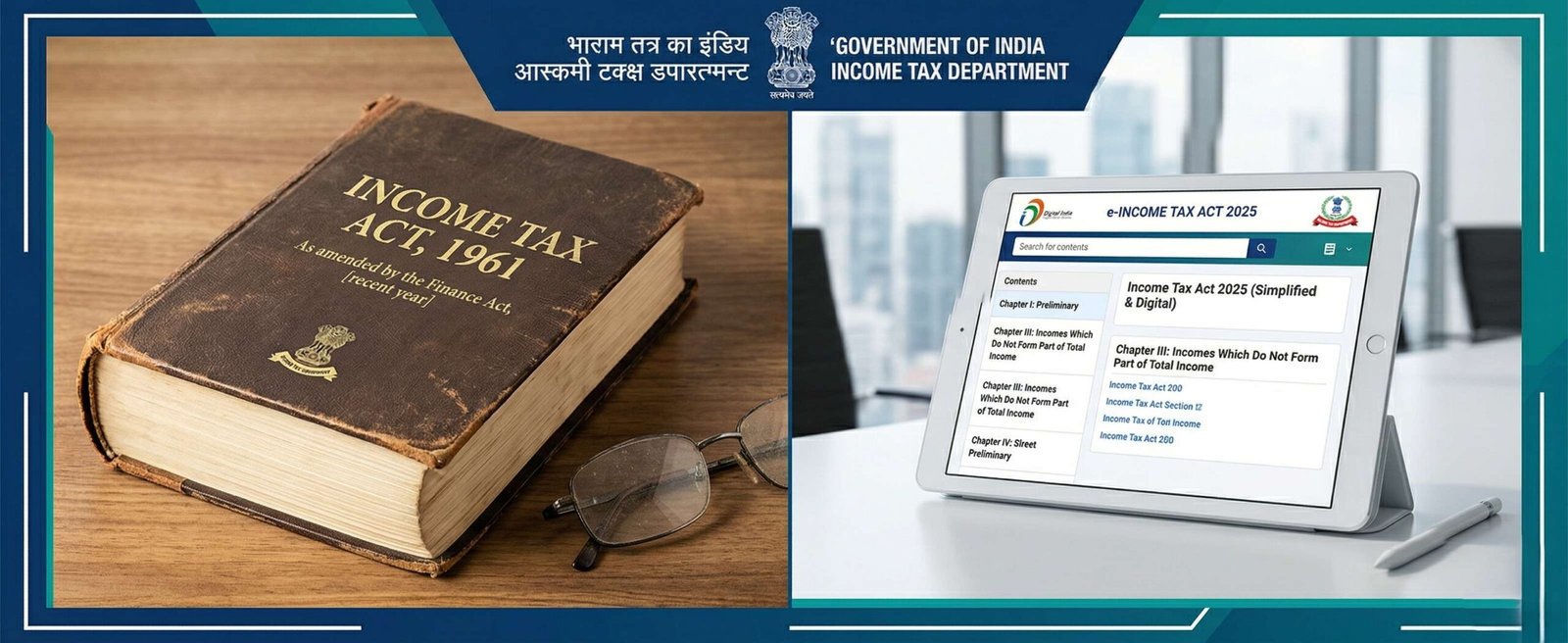
The Income Tax Act 2025 came into force on April 1, 2026, replacing a law that had been in effect since 1961. This is not a minor amendment — it is a structural rewrite of India’s entire direct tax framework, backed by new Income-tax Rules 2026 notified by the CBDT on 20 March 2026. For business owners, the new tax rules April 2026 bring revised deadlines, restructured TDS compliance, updated form numbers, and a simplified vocabulary that eliminates decades of interpretive confusion.
The Act itself is revenue-neutral — tax rates and most deductions are unchanged. What has changed is the administrative and procedural layer: how returns are filed, how TDS is reported, what forms are used, and how timelines are counted. Every founder, CA, CFO, and compliance officer running a business in India needs to understand the Income Tax Act 2025 before the first quarterly TDS return for Tax Year 2026-27 is due.
1 What Is the Income Tax Act 2025 and Why Does It Matter?
The Income Tax Act 2025 was enacted to replace a 1961 statute that had accumulated over 4,000 amendments across six decades, resulting in a document of more than 5 lakh words across 819 sections — described by Finance Minister Nirmala Sitharaman as a “maze.” The new act consolidates the same tax policy into a cleaner 536-section structure with plain language, grouped provisions, and digital-first administration.
The CBDT confirmed via official circular that the 2025 Act governs Tax Year 2026-27 onwards. Critically, the 1961 Act continues to apply for all periods prior to April 1, 2026 — pending assessments, reassessments, appeals, and proceedings for earlier years run under the old law through saving provisions in Section 536 of the new Act. Both statutes will effectively operate in parallel during the transition period.
📌 Transition rule: Your ITR for FY 2025-26 (AY 2026-27), filed in July/August 2026, is still governed by the Income Tax Act 1961. Your first return under the Income Tax Act 2025 will be filed from July 2027 for Tax Year 2026-27. The new form numbers and terminology apply immediately for new TDS filings from April 2026.
2 Single Tax Year: The Most Significant Terminology Change
Under the Income Tax Act 1961, India used two distinct concepts: “Previous Year” (the year in which income was earned) and “Assessment Year” (the following year in which that income was taxed and returns filed). This two-year split created persistent confusion — a taxpayer earned income in FY 2024-25 (Previous Year) but filed and was assessed in AY 2025-26. The two-year terminology misled first-time filers, generated mismatch errors, and made deadline tracking unnecessarily complex.
The Income Tax Act 2025 abolishes this split with a single concept: Tax Year. Income earned between April 1, 2026 and March 31, 2027 belongs to Tax Year 2026-27. The return is filed and assessed within that same Tax Year. The year in which you earn is the year in which you file — full stop.
| Old System (1961 Act) | New System (2025 Act) | Practical Impact |
|---|---|---|
| Previous Year 2025-26 | Tax Year 2025-26 | Same period, same name |
| Assessment Year 2026-27 | Abolished | No separate AY — filing occurs within Tax Year |
| Income earned FY → taxed in AY | Income earned TY → taxed in same TY | Eliminates year-gap confusion |
| Form 16 (TDS certificate) | Form 130 | Update payroll software, employee communications |
| Form 3CD (Tax Audit Report) | Form 26 | Update audit software and engagement templates |
| Loss carry-forward: 8 assessment years | Loss carry-forward: 8 Tax Years | Same duration, consistent terminology |
3 New Tax Rules April 2026: Revised ITR Filing Deadlines
The new tax rules April 2026 bring the most business-friendly deadline change in years: ITR-3 and ITR-4 for non-audit cases are now due August 31, not July 31. This extension applies immediately — it is also applicable to ITR filing for FY 2025-26 (AY 2026-27) due in 2026.
⚠️ Late filing penalty: Missing your ITR deadline under the Income Tax Act 2025 attracts ₹5,000 under the equivalent of Section 234F (₹1,000 if total income is ₹5 lakh or below), plus interest at 1% per month on unpaid tax. The revised return window now extends to March 31, but late fees apply on revised returns filed after December 31.

4 Income Tax Act 2025: TDS Restructuring — What Changes for Businesses
The most operationally disruptive change under the new tax rules April 2026 is the complete renumbering of TDS provisions. Under the 1961 Act, TDS sections were scattered across the statute by income type — Section 194C for contractors, 194J for professionals, 194H for commission, and so on. The Income Tax Act 2025 consolidates all TDS into three master sections:
Every ERP system, TDS software, and accounting tool used by your business must be updated before the first TDS return for Tax Year 2026-27 is due. The CBDT has made clear that CBDT circulars on TDS — including those on perquisites and virtual digital assets — are now explicitly binding on both tax authorities and deductors under Section 400(2) of the new Act. The earlier argument that CBDT circulars were merely advisory no longer holds.
📌 Property purchase from NRI: Under the Income Tax Act 2025, buyers acquiring immovable property from a non-resident can now deduct TDS using only a PAN-based challan — eliminating the earlier mandatory TAN registration. A significant compliance simplification for property-owning businesses and real estate transactions.
5 Tax Slabs and Presumptive Taxation Under Income Tax Act 2025
Tax slabs are unchanged for Tax Year 2026-27 under both regimes. The new tax regime remains the default. Under the new regime, a Section 87A rebate of ₹60,000 makes income up to ₹12 lakh effectively zero-tax for resident individuals. Salaried employees benefit from an additional ₹75,000 standard deduction — making income up to ₹12.75 lakh tax-free in practice. These thresholds continue without change under the Income Tax Act 2025.
| Income Slab (New Regime — Tax Year 2026-27) | Tax Rate |
|---|---|
| Up to ₹4,00,000 | Nil |
| ₹4,00,001 – ₹8,00,000 | 5% |
| ₹8,00,001 – ₹12,00,000 | 10% |
| ₹12,00,001 – ₹16,00,000 | 15% |
| ₹16,00,001 – ₹20,00,000 | 20% |
| ₹20,00,001 – ₹24,00,000 | 25% |
| Above ₹24,00,000 | 30% |
For small business owners and freelancers, the presumptive taxation changes under the new tax rules April 2026 are especially significant. The turnover thresholds for presumptive taxation have been revised upward:
Need Help Transitioning to the Income Tax Act 2025?
Validraft’s compliance team assists businesses with TDS software updates, ITR regime selection, and Tax Year 2026-27 filing strategy under the new Act.
Get a Free Tax Consultation → View Tax Filing Services6 Other Key Changes Under New Tax Rules April 2026
Beyond structure and deadlines, the Income Tax Act 2025 introduces several specific rule changes that affect business finances, payroll, and investments in Tax Year 2026-27.
7 Income Tax Act 2025 vs 1961: What’s the Same, What’s Different
- 📋 “Assessment Year” — abolished
- 📋 “Previous Year” — replaced by “Tax Year”
- 📋 All TDS section numbers reassigned
- 📋 Form 16 → Form 130
- 📋 Form 3CD → Form 26
- 📋 ITR-3/4 deadline: July 31 → August 31
- 📋 Revised return deadline: Dec 31 → March 31
- 📋 Presumptive limits raised (44AD/44ADA)
- 📋 Buyback tax treatment changed
- 📋 HRA metro cities expanded to 8
- ✓ Tax slabs — unchanged for FY 2026-27
- ✓ Section 87A rebate — ₹60,000 intact
- ✓ Zero tax threshold — ₹12L (new regime)
- ✓ Standard deduction — ₹75,000 for salaried
- ✓ Tax audit deadline — October 31
- ✓ New regime as default tax regime
- ✓ Capital gains rates on equities/property
- ✓ TDS rates (only section numbers changed)
- ✓ Loss carry-forward: 8 Tax Years
- ✓ Most deductions — unchanged in principle
8 Compliance Action List for Business Owners — April 2026
The Income Tax Act 2025 requires immediate action on several fronts. The following checklist covers what every business owner and CFO must address in the first quarter of Tax Year 2026-27:
Navigate the Income Tax Act 2025 With Confidence
Validraft helps founders and MSMEs align their compliance, contracts, and filing strategy with the new Income Tax Act 2025 and new tax rules April 2026.
Book a Compliance Review → All Compliance Services9 Frequently Asked Questions — Income Tax Act 2025
10 Conclusion: What the Income Tax Act 2025 Means for Your Business
The Income Tax Act 2025 is not a tax increase — it is a tax modernisation. For most business owners, the new tax rules April 2026 do not change how much you pay; they change how you report, what forms you use, and how your compliance software and documentation must be structured. The danger zone is operational: businesses that continue using old TDS section codes, old form numbers, or old deadline assumptions will face validation errors, late fees, and avoidable compliance exposure from the very first quarter of Tax Year 2026-27.
The extended ITR-3/4 deadline, higher presumptive taxation thresholds, and simplified TDS structure under the Income Tax Act 2025 are genuine wins for founders and MSMEs. The single Tax Year concept eliminates decades of terminological confusion. The expanded HRA metro list, lower TCS on foreign travel, and the TDS refund window for late filers are practical benefits for growing businesses. The transition is manageable — but it requires action now, not at the filing deadline.
Validraft’s compliance and legal team is working with founders and finance teams across India to implement the new Act’s requirements — from updating agreements and vendor contracts that cite old section numbers, to filing strategy reviews under the new Income Tax Act 2025. If your business needs a structured transition plan for Tax Year 2026-27, reach out before your first quarterly TDS return is due.