

Delhi’s Cloud Kitchen Boom is Real —
But Most Are Operating Without This One Licence
The FSSAI licence is the single non-negotiable legal requirement every Delhi cloud kitchen must hold before taking its first order. Here’s exactly what you need, what it costs, and what’s at stake if you don’t have it.
Basic FSSAI
Govt Fee (per year)
Max Penalty
Without Licence
Authority Must
Act on Application
FSSAI Number
on All Packaging
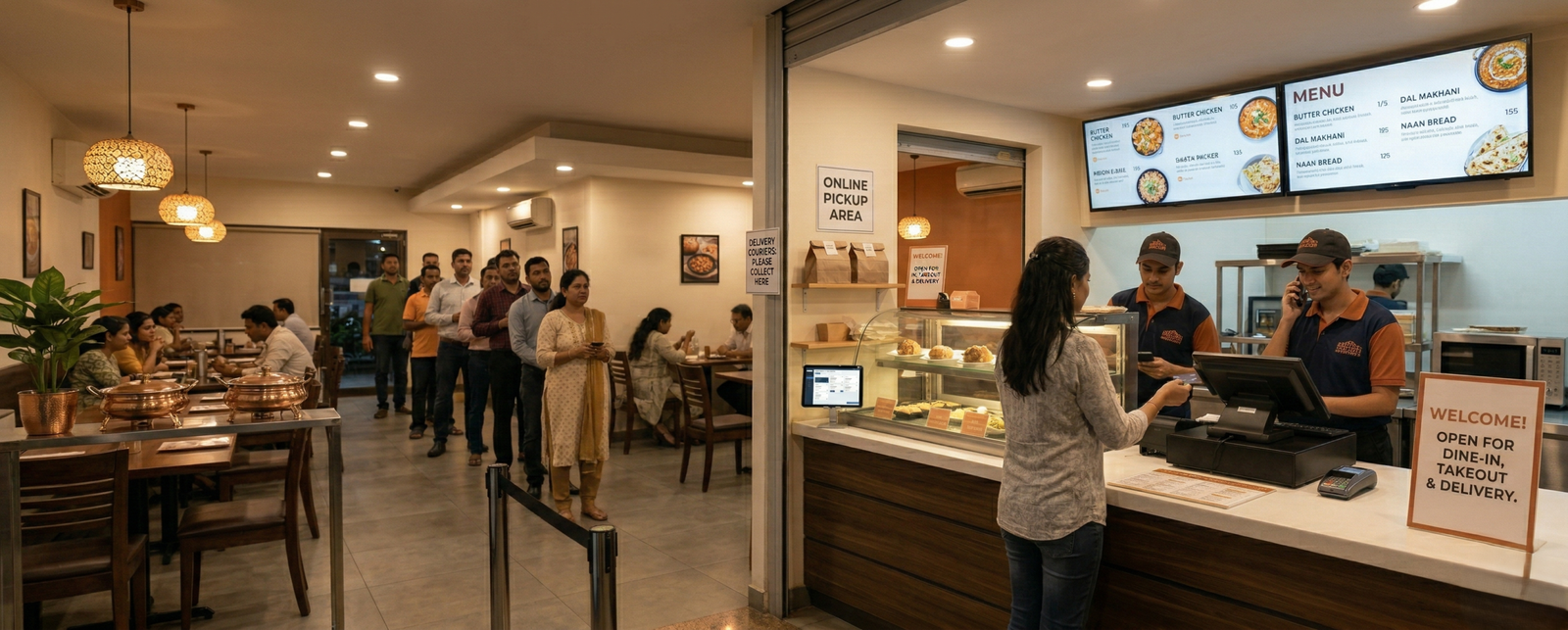
- Mandatory without exception: Every cloud kitchen, dark kitchen, or virtual restaurant operating in Delhi — including home-based setups — must hold a valid FSSAI licence or registration under the Food Safety and Standards Act, 2006. This applies regardless of whether you have a Swiggy or Zomato listing.
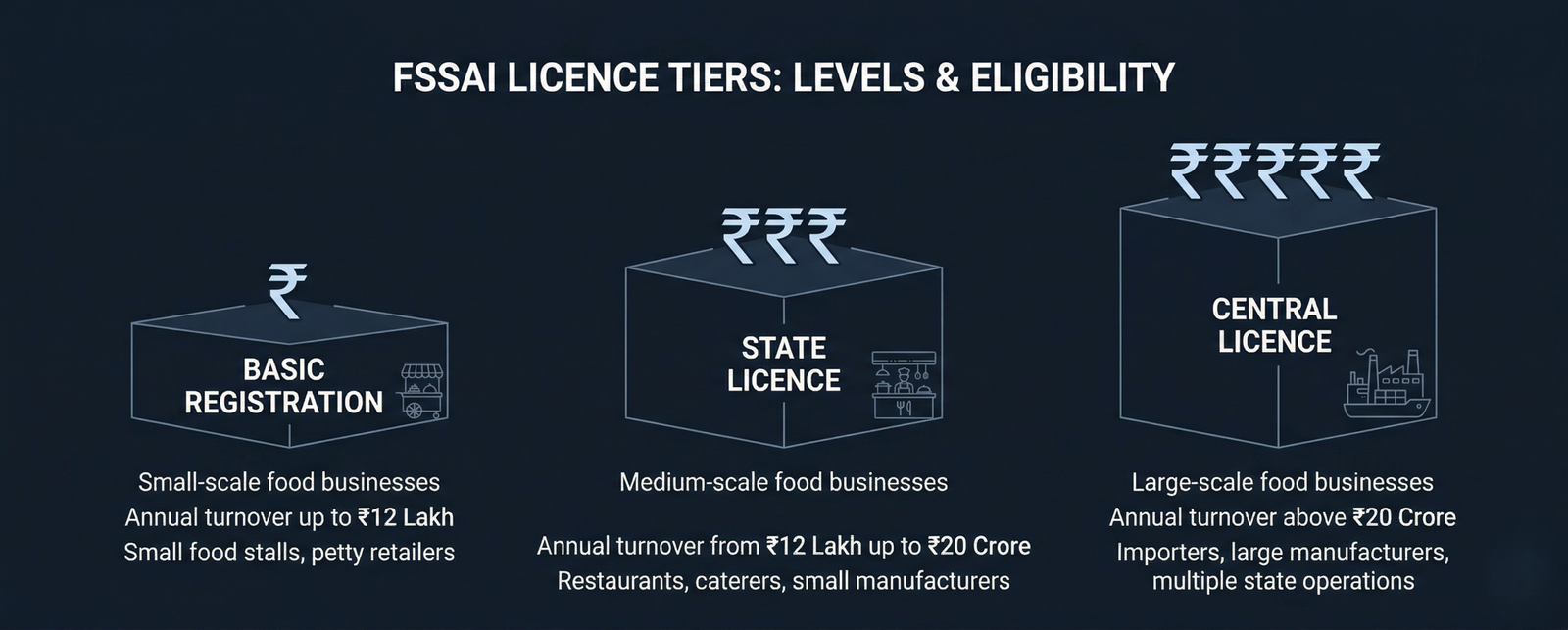
- Licence type is turnover-linked: Turnover under ₹12 lakh per year → Basic Registration (₹100/yr). Between ₹12 lakh and ₹20 crore → State Licence (₹2,000–₹5,000/yr). Above ₹20 crore or operating in multiple states → Central Licence (₹7,500/yr). All applications go through foscos.fssai.gov.in.
- One licence covers multiple virtual brands: Multiple food brands operating from the same kitchen address are covered under a single FSSAI licence for that premises — provided all brand names are listed on the certificate. No separate licence is needed per brand.
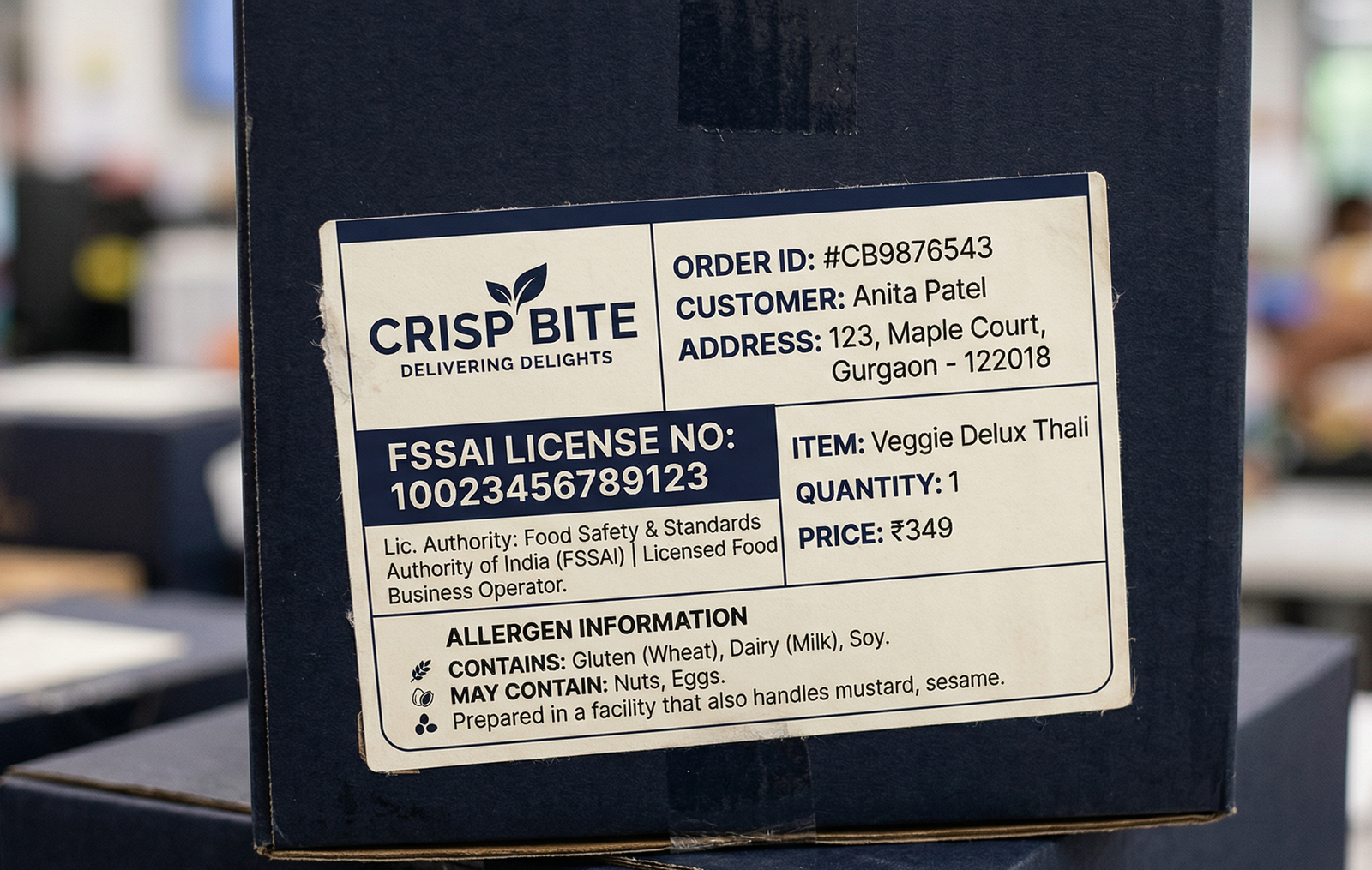
- Platform onboarding blocked without it: Both Swiggy and Zomato verify your 14-digit FSSAI number against the FoSCoS database before activating your listing. An expired, mismatched, or missing licence suspends your listing automatically.
- Penalties are severe: Operating a food business without an FSSAI licence is a criminal offence under the FSS Act, 2006, carrying fines up to ₹5 lakh and potential business closure by the licensing authority.
Delhi’s cloud kitchen market has grown into a dense network of delivery-only operations across Lajpat Nagar, Janakpuri, Rohini, Saket, and virtually every residential pocket in the NCR. The model is attractive: low capital, zero dine-in infrastructure, multiple cuisine brands from one kitchen. But there’s a legal layer that a significant portion of new operators skip — or don’t fully understand — before taking their first Swiggy order.
1 Why Cloud Kitchens in Delhi Need an FSSAI Licence — Legally, Not Just Practically
The Food Safety and Standards Act, 2006 — the central legislation governing every food business in India — does not create a category called “cloud kitchen.” Under the Act, a cloud kitchen is a Food Business Operator (FBO). The moment you prepare food for commercial sale, whether from a rented commercial space in Uttam Nagar or your own flat in Dwarka, you are operating as an FBO and you are legally required to hold an FSSAI licence or registration before commencing operations.
There is no carve-out for delivery-only operations. There is no exemption for small-order volumes. There is no grace period after incorporation. The legal requirement attaches to the first commercial food transaction — not to the first month of operations or the first ₹12,000 in revenue. Two categories of Delhi operators routinely misread their position:
🏠 Home-Based Cloud Kitchens
Operating from a residential kitchen for delivery doesn’t exempt you from FSSAI requirements. You still need at minimum a Basic FSSAI Registration. Many founders assume that the absence of a commercial premises means absent compliance. That assumption is incorrect and is one of the most common causes of enforcement action against small food businesses in Delhi.
📦 Multi-Brand Operators
Founders running three cuisine brands from one kitchen sometimes believe each brand needs its own licence. This is incorrect. One licence covers one premises address — all virtual brands operating from that address must be listed on the same certificate. The error here is usually the opposite: forgetting to list new brands when they’re added, which creates a category mismatch that can trigger penalties of up to ₹2 lakh.
2 Which FSSAI Licence Does Your Delhi Cloud Kitchen Need?
FSSAI issues three tiers of food business licences in Delhi. Your turnover, geographic spread, and type of food product determine which tier applies to you. Choosing the wrong tier is not just an administrative inconvenience — operating under a licence category below your actual scale is a non-compliance event under the FSS Act, 2006.
| Licence Type | Annual Turnover | Govt Fee | Form | Typical Delhi Cloud Kitchen |
|---|---|---|---|---|
| Basic Registration | Up to ₹12 lakh | ₹100 per year | Form A | Home kitchen, single-brand starter |
| State Licence | ₹12 lakh – ₹20 crore | ₹2,000 – ₹5,000 per year | Form B | Commercial rented kitchen, multi-brand, Swiggy/Zomato listed |
| Central Licence | Above ₹20 crore OR multi-state operations | ₹7,500 per year | Form B | Chain cloud kitchen operating in Delhi + Gurgaon + Noida simultaneously |
The practical reality for most Delhi NCR cloud kitchens in 2026: If you are operating from a single kitchen address, serving one or multiple brands through Swiggy and Zomato, with annual turnover under ₹20 crore, you need a State Licence — not Basic Registration. Aggregators themselves require a State Licence for operations involving high-risk food categories such as meat, dairy, and cooked meals, which is the vast majority of Delhi cloud kitchen menus. Apply via foscos.fssai.gov.in.
3 What a Delhi Cloud Kitchen FSSAI Licence Costs — Government Fees Only
Government fees for FSSAI licences are fixed by FSSAI nationally and are low by design. The cost barrier to compliance is minimal. The only reason to operate without a valid food business licence in Delhi NCR 2026 is failure to apply — not financial constraint.
The licence is valid for 1 to 5 years — you choose the validity period at the time of application and pay accordingly. Choosing a 5-year validity at the time of first registration is almost always the correct decision: the per-year fee is identical, but you avoid renewal administration and the risk of a lapse penalty. A late renewal application (submitted after the 30-day pre-expiry window) attracts a ₹100 per day late fee via FoSCoS, and an expired licence requires a fresh application from scratch.
4 Documents Required for Delhi Cloud Kitchen FSSAI Licence
Document completeness at the time of first submission is the single largest variable in how fast your application moves through the FoSCoS system. Authorities have 7 working days from receipt to either act on your application or issue a non-conformity notice. An NCR (Non-Conformity Report) due to missing documents resets that clock.
- ✓Photo identity proof and address proof of the business owner / authorised signatory (Aadhaar and PAN accepted)
- ✓Proof of kitchen premises: Electricity bill in owner’s name OR registered rent agreement / leave and licence agreement for the kitchen address
- ✓Business constitution document: Certificate of Incorporation + MoA/AoA (Private Limited), or LLP deed, or partnership deed, or GST registration for proprietorships
- ✓Complete list of food categories being prepared and sold (must match your actual menu — this is what gets printed on the licence certificate)
- ✓Layout plan of the kitchen premises (simple floor sketch showing kitchen area, storage area, entry — hand-drawn is accepted for State licences)
- ✓Food Safety Management System (FSMS) Plan — a written document describing your cleaning schedule, pest control, food storage temperatures, waste disposal, and supplier verification procedures
- ✓Equipment and machinery list (refrigerators, cooking range, packaging equipment — make, model, capacity)
- !If the kitchen involves meat, seafood, or dairy: additional documents may be required by the Delhi FSSAI authority — confirm at foscos.fssai.gov.in before submitting
- !All brand names operating from the kitchen premises must be declared in the application — they will be printed on the licence certificate. Adding a new brand after issuance requires a paid modification application (₹1,000)
5 Step-by-Step: Applying for Your FSSAI Licence on FoSCoS
The FSSAI food business licence application in Delhi is entirely online via the Food Safety Compliance System. No physical office visit is required at the application stage. Inspection, if triggered, is conducted at your premises by a Food Safety Officer.
6 Penalties for Operating Without an FSSAI Licence in Delhi
The FSS Act, 2006 does not treat unlicensed food operations as a minor procedural lapse. It treats them as a criminal offence. The penalties are structured across multiple sections and can compound rapidly if a kitchen is operating under multiple violations simultaneously.
7 Beyond FSSAI: Other Licences a Delhi Cloud Kitchen Should Hold
The FSSAI licence is the one licence you can’t operate without — but it’s not the only compliance a Delhi cloud kitchen should carry. The following registrations are either mandatory or strongly advisable depending on your structure and scale.
| Licence / Registration | Applicable To | Authority | Notes |
|---|---|---|---|
| FSSAI Licence | All cloud kitchens | FSSAI / FoSCoS | Mandatory before first order. Non-negotiable. |
| GST Registration | Turnover exceeding ₹20 lakh (₹10 lakh for special category states) | gst.gov.in | Mandatory if threshold crossed. Aggregators report your payouts to GST authorities. |
| Shop and Establishment Registration | Commercial kitchen premises in Delhi | Delhi Labour Department | Mandatory for commercial premises. Home kitchens typically exempt if no employees. |
| Fire NOC | Commercial kitchen with LPG / gas connection | Delhi Fire Service | Required for most commercial kitchen spaces. May be required by landlord/building management. |
| Udyam Registration (MSME) | All cloud kitchens eligible as micro/small businesses | udyamregistration.gov.in | Free. Enables access to MSME schemes, priority lending, and government procurement benefits. |
Get Your Delhi Cloud Kitchen Fully Licensed in 2026
Validraft handles FSSAI licence applications, FSMS plan preparation, and all ancillary food business registrations for Delhi NCR operators — so you focus on the kitchen, not the paperwork.
Get a Free Consultation → View Licence Services8 The Most Common FSSAI Compliance Mistakes Delhi Cloud Kitchens Make
These are the errors that generate enforcement notices, platform suspensions, and penalty proceedings in Delhi NCR food operations. Most are entirely preventable with a one-time correct setup.
- ✗Wrong licence category from the start: Applying for Basic Registration when you expect to cross ₹12 lakh in year one. The correction requires a fresh State Licence application — you can’t upgrade a Basic Registration in place. You’ll also face a penalty exposure window during the gap period.
- ✗Kitchen address mismatch: Listing your registered office address instead of the actual kitchen address in the application. FSSAI geo-tagging in 2026 cross-checks physical locations. A mismatch triggers a non-conformity notice and potential cancellation.
- ✗Undeclared food categories: Adding chicken biryani to your menu without having “meat and meat products” or “cooked food” declared in your licence. Operating outside declared categories carries a ₹2 lakh penalty. Update your food category list via a modification application (₹1,000 fee) before expanding the menu.
- ✗New brand, no update: Launching a second virtual brand from the same kitchen without adding the brand name to the existing licence. FoSCoS requires all brand names at a premises to be listed. A new brand listed on Zomato but absent from your FSSAI certificate is a compliance gap.
- !Expired licence, active listing: Swiggy and Zomato’s API checks in 2026 run against live FoSCoS data. An expired FSSAI number deactivates your listing without advance warning. Set a calendar reminder 60 days before your licence expiry to initiate renewal.
- !No FSMS plan: For State licences, a Food Safety Management System Plan is mandatory. A generic template downloaded from the internet without adapting it to your actual kitchen operations will fail inspection. Inspectors look for specifics: your fridge temperature log, your supplier list, your cleaning chemical inventory.
9 Conclusion — The Licence Fee Is ₹2,000. The Penalty Is ₹5 Lakh.
The FSSAI licence for a Delhi cloud kitchen is not a bureaucratic formality — it is the legal instrument that permits you to be a food business in India. The government fee for a State Licence starts at ₹2,000 per year. The penalty for operating without one starts at the same amount and extends to ₹5 lakh plus imprisonment. The risk-adjusted math is unambiguous, and yet a substantial share of Delhi NCR cloud kitchen operators either don’t hold the correct licence category or have let their registration lapse entirely — discovered only when their Swiggy listing goes dark.
The food business licence requirement in Delhi NCR 2026 has become harder to ignore, not easier. FSSAI’s FoSCoS integration with aggregator onboarding APIs means non-compliance is now surfaced automatically and publicly — your listing deactivates without a phone call from any authority. The administrative path to compliance is straightforward: Form B on foscos.fssai.gov.in, correct food category declaration, a site-specific FSMS plan, and a 5-year validity selection. Done once, correctly, it requires nothing more than a renewal alert.
If your Delhi cloud kitchen is already operating — even informally — the time to apply for the FSSAI licence is before your next order goes out, not after your first enforcement notice arrives. Validraft handles the application, document preparation, and FSMS plan drafting so there are no gaps between your kitchen going live and your compliance being complete.
? Frequently Asked Questions
📎 Authoritative Sources
- → foscos.fssai.gov.in — FSSAI Food Safety Compliance System (Application Portal)
- → foscos.fssai.gov.in — Apply for New Licence / Registration
- → fssai.gov.in — Kind of Business Eligibility and Fee Schedule (Official PDF)
- → fssai.gov.in — Food Safety and Standards Act, 2006 (Full Text)
- → fssai.gov.in — FSS (Licensing and Registration of Food Businesses) Regulations, 2011
- → gst.gov.in — GST Registration (for cloud kitchens crossing threshold)
- → udyamregistration.gov.in — Udyam / MSME Registration